








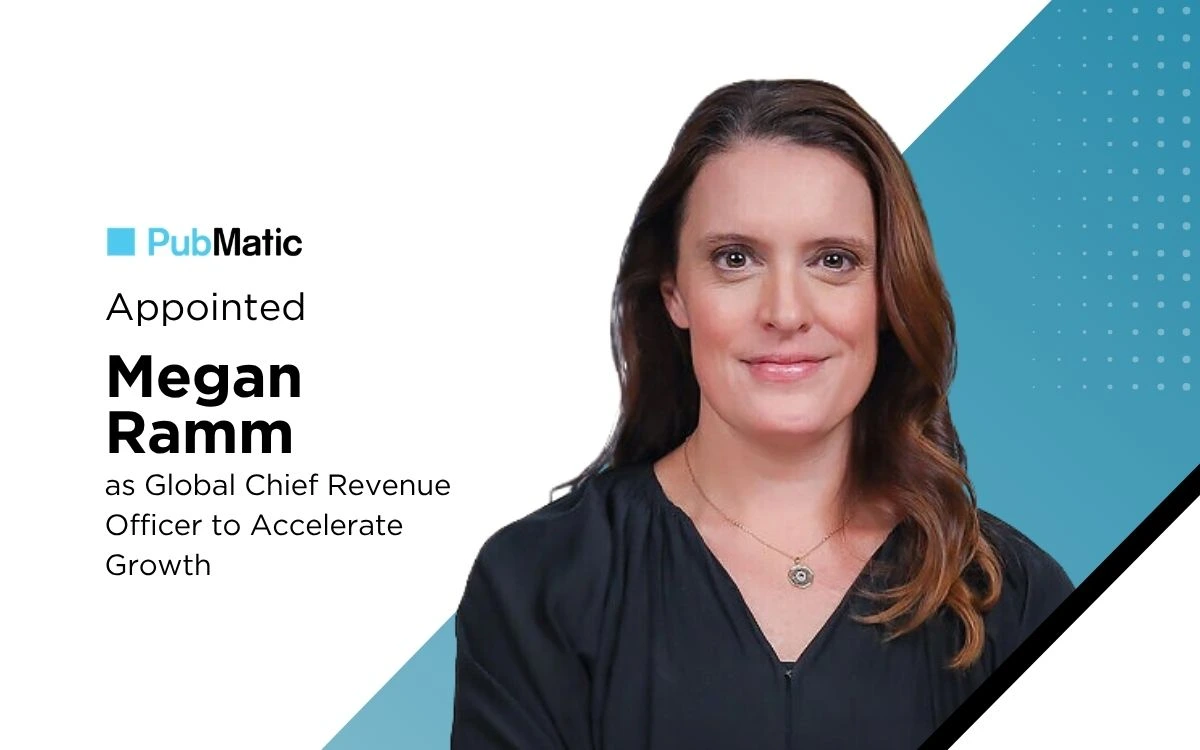
PubMatic is putting a veteran ad-sales executive in charge of its next growth push, naming Megan Ramm as global chief revenue officer as artificial intelligence increasingly changes how brands buy digital media.
Ramm joins PubMatic after serving as head of global sales at Uber Advertising, where she led a sales organization responsible for relationships with major brands and agencies. She will be based in New York and oversee PubMatic’s global revenue strategy across the Americas, Europe, the Middle East and Africa, and Asia-Pacific.
The appointment is more than a routine executive shuffle. For PubMatic, it marks a shift in emphasis from building AI-powered advertising technology to convincing more advertisers and agencies to use it at scale.
That distinction matters.
The advertising industry has spent years automating the mechanics of media buying. The newer battleground is deciding how much of that process can be handed to software that can reason, optimize and act with less human intervention. PubMatic is betting that its position in the programmatic supply chain gives it a useful perch from which to make that transition.
Ramm’s mandate will cover performance advertising, connected TV, mobile apps and what PubMatic calls agentic advertising, while also deepening relationships with brands, agencies, demand-side platforms and publishers.
In other words, the company wants more of the money flowing through the ecosystem to flow through PubMatic.
From Uber to PubMatic
Ramm brings a résumé that spans several generations of digital advertising.
Before Uber Advertising, she was an early sales leader at Snap. She also spent six years at Google working across search and programmatic advertising sales, after beginning her media career at Forbes and Reuters.
That background gives her experience on both sides of a major change in advertising: the shift from selling media largely through human relationships to selling increasingly automated, data-driven campaigns through software platforms.
Uber Advertising is particularly relevant to PubMatic’s ambitions. Retail media and app-based advertising have made first-party data, performance measurement and closed-loop optimization increasingly important to advertisers. Uber’s advertising business sits at the intersection of consumer data, commerce and performance marketing, areas that overlap with PubMatic’s broader push into performance advertising and commerce-oriented opportunities.
Ramm’s experience also puts her closer to the advertiser and agency side of the equation than a traditional sell-side advertising executive might be.
That could prove important for an SSP such as PubMatic.
Supply-side platforms historically made their money by helping publishers sell advertising inventory more efficiently. But the business has evolved. Publishers still need monetization tools, while advertisers increasingly want direct access to quality inventory, better targeting, more transparency and fewer intermediaries.
PubMatic has been pushing into that middle ground through products such as Activate, which allows buyers to transact directly with publisher inventory, alongside its broader AI and agentic initiatives.
Ramm’s job will be to make that proposition compelling to the people controlling advertising budgets.
PubMatic’s AI bet is moving beyond the buzzword stage
PubMatic’s executive appointment comes after a series of aggressive moves around AI.
The company launched AgenticOS in 2026 as an environment designed to let AI agents participate in programmatic advertising workflows. In its first-quarter results, PubMatic said more than 1,000 AI-powered deals had already transacted through AgenticOS and that more than 20 AI agents were available on the platform. It also said it had launched more than 30 fully autonomous, end-to-end campaigns globally.
Those numbers provide useful context for Ramm’s appointment.
PubMatic is not positioning AI merely as a feature that makes a dashboard slightly smarter. It wants AI to become part of the machinery used to plan, activate and optimize campaigns.
The company’s recent product activity supports that strategy. PubMatic has announced Decision Fabric for AgenticOS, a Creator Marketplace intended to connect content creators with emerging agentic demand, and agentic CTV initiatives with advertising partners. Its investor-relations site lists those launches among its major 2026 announcements.
The industry is moving in a similar direction, although companies are taking different routes.
DSPs such as The Trade Desk are competing primarily for advertiser budgets and are using AI to improve targeting, bidding, optimization and measurement. SSPs including PubMatic and Magnite traditionally sit on the publisher side, helping sellers maximize the value of their inventory. Google and Amazon have the unusual advantage of operating across multiple parts of the advertising stack, while commerce platforms increasingly bring their own first-party data into the auction.
That makes the old distinction between “buy side” and “sell side” less tidy than it used to be.
PubMatic itself has acknowledged that the lines between SSPs and DSPs are blurring. Its 2025 results highlighted the company’s strategy of diversifying its DSP mix, expanding CTV and investing in higher-growth areas.
Ramm’s arrival fits neatly into that strategy.
The real test: Can PubMatic turn AI into advertiser demand?
AI demos are easy. Changing where advertisers spend money is considerably harder.
That is likely to be the central test of Ramm’s tenure.
PubMatic has invested heavily in the infrastructure and software needed to automate advertising workflows. But an AI-powered platform ultimately needs buyers. Advertisers and agencies need to believe that the technology can improve outcomes, reduce operational costs or provide access to inventory they cannot efficiently reach elsewhere.
That is why Ramm’s background matters more than the title itself.
At Uber Advertising, she was responsible for building relationships with large brands and agencies. At Google, she worked in search and programmatic sales. At Snap, she was part of an early sales organization during a period when the company was establishing itself as an advertising platform.
Those are useful experiences for a company attempting to move from being primarily infrastructure for digital advertising transactions to being a more visible part of the advertiser’s decision-making process.
PubMatic CEO and co-founder Rajeev Goel described Ramm as someone who understands the advertiser journey and has experience building sales organizations.
That is corporate-speak for a fairly straightforward challenge: PubMatic needs to sell the outcome, not just the technology.
Why agentic advertising changes the pitch
Traditional programmatic advertising already automates a remarkable amount of work.
A campaign can use software to select audiences, evaluate impressions, submit bids, manage budgets and optimize toward performance goals. But people still have to configure many of the rules, connect systems, monitor results and make decisions when circumstances change.
Agentic advertising attempts to push that automation further.
Instead of simply executing predefined instructions, AI agents can potentially interpret objectives, make decisions across multiple steps and adjust workflows based on performance.
The appeal for agencies is obvious. Campaign setup can consume substantial amounts of time, particularly when teams are juggling multiple platforms, inventory sources, audiences and reporting systems.
PubMatic’s own first-quarter disclosures offer an early glimpse of what it is trying to accomplish. The company said one agentic campaign in France reduced setup time by 80%, while other campaigns were designed to automate tasks and optimize CTV buying.
The catch is equally obvious.
Advertisers are not going to hand over increasingly consequential media decisions to AI simply because a platform labels something “agentic.”
They will want control, transparency, brand safety, measurable performance and a clear explanation of what the software actually did.
That puts Ramm’s sales and customer-facing responsibilities directly in the spotlight. PubMatic needs to persuade agencies that agentic advertising does not mean “let the robot spend the budget and hope for the best.”
CTV remains a major battleground
Connected TV is another reason this appointment matters.
CTV has become one of the most competitive areas in programmatic advertising because it combines the scale and targeting capabilities of digital advertising with the premium economics traditionally associated with television.
PubMatic has made CTV a central part of its growth strategy. In the second quarter of 2025, the company said omnichannel video revenue, including CTV, increased 34% year over year and represented 41% of total revenue, while CTV revenue itself grew more than 50%.
CTV also happens to be a natural environment for AI-driven optimization.
There is a lot of inventory, fragmented viewing behavior and growing pressure on advertisers to prove that television spending produces measurable business results. The companies that can connect inventory, audience signals, bidding and measurement efficiently have an opportunity to capture more of that budget.
But competition is intense.
Magnite is a major independent player in the sell-side market and has built a substantial CTV business. The Trade Desk competes aggressively on the buy side, while Google, Amazon and major media companies bring their own combinations of inventory, data and advertising technology.
For advertisers, the practical question is less “Which company has the most AI?” and more “Which platform gives me the best combination of reach, performance, transparency and control?”
That is a much tougher sales pitch.
PubMatic is also chasing mobile and performance advertising
Ramm’s remit extends beyond CTV.
PubMatic says she will oversee expansion in performance advertising and mobile app advertising, two markets where optimization and measurable outcomes are particularly important.
The company’s first-quarter results showed mobile app revenue growing more than 25% year over year, while emerging revenue grew more than 80% and accounted for roughly 14% of total revenue. PubMatic attributed part of that emerging category to newly launched AI solutions.
The company also said ad spend through Activate more than tripled year over year in the first quarter, while ad spend from mid-market-focused DSPs grew more than 20%. Supply Path Optimization, meanwhile, represented more than 56% of platform activity.
Those metrics point to a broader strategy.
PubMatic does not want its growth story to depend on one advertising format or one class of buyer. It is attempting to build a more diversified platform spanning publishers, agencies, DSPs, CTV, mobile apps, commerce media and increasingly autonomous advertising workflows.
That diversification is particularly important after the company dealt with changes involving a major DSP buyer.
In its first-quarter results, PubMatic said that excluding a legacy DSP, its underlying business grew 13% year over year and represented 83% of total revenue. The company also said it expected to return to double-digit revenue growth in the second half of 2026.
Ramm is arriving at precisely that inflection point.
A better-connected ad market—or a more complicated one?
There is an interesting paradox at the heart of PubMatic’s strategy.
The promise of AI in advertising is simplification. Fewer manual workflows. Faster campaign activation. More efficient bidding. Better optimization.
Yet the advertising ecosystem itself continues to become more complicated.
Brands work with agencies. Agencies use DSPs. DSPs connect to SSPs. Publishers work with multiple SSPs. Retailers operate commerce media networks. CTV platforms have their own inventory and data. AI agents are now being layered on top of many of these systems.
The technology may be getting smarter while the stack gets messier.
Supply Path Optimization emerged partly in response to that problem. Advertisers want to know how their money travels through the programmatic ecosystem and how much value reaches publishers. PubMatic has emphasized SPO as part of its platform strategy, with more than half of its platform activity coming through SPO in Q1 2026.
Agentic advertising could either simplify that environment or add another layer of abstraction.
If agents can independently evaluate supply paths and select efficient inventory, they could reduce unnecessary complexity. If every vendor launches its own proprietary agent, however, advertisers could simply end up with another collection of black boxes to manage.
The winner will likely be the platform that makes automation easier without making accountability harder.
PubMatic’s timing is deliberate
The appointment also follows a period in which PubMatic has been rebuilding its growth narrative.
The company entered 2026 after a difficult period for independent ad tech, including pressure from changes by a major DSP buyer. Its first-quarter results showed revenue of $62.6 million, down slightly from $63.8 million a year earlier, but the company said its underlying business was growing and that AI adoption was creating new revenue opportunities.
At the time, PubMatic forecast second-quarter revenue of $68 million to $70 million and adjusted EBITDA of $8 million to $10 million.
The company’s latest announcement says second-quarter performance returned it to double-digit year-over-year revenue growth ahead of schedule, alongside expanded profitability and continued momentum in AI-native and higher-growth businesses.
That creates a more favorable backdrop for bringing in a high-profile sales leader.
Ramm is not being asked to rescue a business in free fall. She is being brought in while PubMatic believes it has products gaining traction and an opportunity to accelerate that momentum.
That is a considerably more attractive sales pitch to both an executive and the market.
The executive hire says something about where ad tech is heading
There is a larger industry trend hiding inside the appointment.
For years, ad-tech companies could differentiate themselves through infrastructure: faster auctions, better integrations, larger pools of inventory or more sophisticated targeting.
AI is changing the basis of competition.
Infrastructure still matters, but the next generation of platforms increasingly wants to make decisions on behalf of customers. That means companies need executives who can translate technical capabilities into business outcomes.
Ramm’s background is particularly suited to that transition because her career has tracked several of the industry’s biggest shifts.
Reuters and Forbes represent the traditional media environment. Google represents the industrialization of digital advertising and programmatic buying. Snap represents mobile and social advertising. Uber Advertising represents the rise of first-party data and commerce-driven performance marketing.
PubMatic represents another piece of the puzzle: the infrastructure that connects buyers with publishers.
Put those experiences together and the company is betting that Ramm understands where advertisers have been, where they are now and where they want to go next.
Whether she can persuade them to take that journey through PubMatic is the more interesting question.
Rival pressure will keep the bar high
PubMatic operates in a market where there is little room for complacency.
Magnite remains a major independent SSP competitor, while OpenX and other supply-side platforms compete for publisher relationships and advertising demand. On the buy side, The Trade Desk, Google and other DSPs compete for the budgets that PubMatic ultimately wants to influence. Industry comparisons routinely put PubMatic alongside Magnite, OpenX, Google and The Trade Desk, although the platforms do not all compete in exactly the same parts of the stack.
That distinction is important.
Calling every ad-tech company a direct competitor creates more confusion than clarity. An SSP, DSP, ad server, commerce media platform and social advertising network can all compete for pieces of the same advertising dollar while performing very different jobs.
The competitive battlefield is therefore shifting toward control of the workflow.
Who decides which inventory is valuable? Who controls the data? Who optimizes the bid? Who measures the result? Who owns the relationship with the advertiser? And increasingly, which AI agent gets to make the decision?
Those questions could matter more than traditional labels such as SSP and DSP.
PubMatic’s decision to install a global CRO with deep advertiser and agency experience suggests it wants a larger role in those decisions.
What Ramm has to prove
The first phase of Ramm’s job will probably be less glamorous than the AI headlines suggest.
She will need to translate PubMatic’s technology into repeatable sales motions across thousands of potential advertisers, agencies and partners.
That means proving that AgenticOS can deliver results beyond early pilots. It means convincing agencies that automation can reduce costs without sacrificing control. It means expanding relationships with brands while preserving the publisher economics that underpin PubMatic’s business.
It also means making the company’s growing list of products feel like one platform rather than a collection of adjacent advertising technologies.
That last part could be crucial.
PubMatic describes its strategy as a unified, AI-powered platform connecting buyers, publishers, data partners and commerce media networks.
For a technology buyer, “unified platform” can sound suspiciously like a vendor’s way of saying “please buy more things from us.”
The proof will be in the workflow.
If a brand can access premium inventory, activate campaigns, optimize performance, use AI agents, measure outcomes and maintain transparency without stitching together half a dozen systems, the pitch becomes much more compelling.
Ramm’s experience selling to large brands and agencies could help make that case.
The bigger bet is on the next interface to advertising
The most consequential part of PubMatic’s strategy may ultimately have little to do with traditional ad-tech interfaces.
For decades, humans have interacted with advertising platforms through dashboards. They select audiences, budgets, inventory, bids and campaign objectives by clicking through forms and menus.
Agentic advertising suggests a different interface.
An advertiser could eventually specify a business goal in natural language, provide constraints and let software determine how to execute the campaign across inventory and channels.
That would represent a meaningful change in how advertising technology is used.
But it would also change what advertisers expect from their vendors. Performance would become more important than feature counts. Transparency would become more important than dashboard complexity. And trust would become a product feature rather than merely a compliance requirement.
PubMatic appears to believe it has an opportunity to occupy that layer.
Ramm’s appointment is the commercial side of that bet.
She will lead a global revenue organization at a time when PubMatic is trying to convince the advertising industry that AI can do more than optimize individual transactions. The company’s vision is that AI agents can become active participants in the advertising supply chain.
That is an ambitious proposition.
And unlike a new product announcement, it cannot be measured by how impressive the demo looks.
It will be measured in advertising dollars.
What comes next
For PubMatic, the immediate priorities are clear: expand advertiser and agency relationships, grow performance advertising and CTV, deepen mobile app activity, and turn its agentic advertising technology into a scalable commercial business.
Ramm’s arrival gives the company an executive whose career has been built around exactly that kind of customer expansion.
The timing is also notable. PubMatic says it has returned to double-digit year-over-year revenue growth ahead of schedule, while its AI-powered products and higher-growth businesses continue to gain traction. That gives Ramm a stronger starting position than the company had earlier in the year.
Still, the advertising market has a short memory for promising technology and a long memory for disappointing results.
PubMatic now has to show that its AI strategy can produce durable revenue, not just impressive campaign statistics.
If it can, Ramm’s appointment could prove to be an important step in transforming PubMatic from an infrastructure provider into a more influential platform for advertisers and agencies.
If it cannot, the industry will have learned another familiar lesson: AI can automate a media buy, but it cannot manufacture demand.
For now, PubMatic is betting that the next phase of digital advertising belongs to platforms capable of doing both.
Power Tomorrow’s Intelligence — Build It with TechEdgeAI