






1. Context without governance produces confident answers built on the wrong information. Context with governance that is too restrictive produces a system that can’t do useful work. Where is that line and who in an organization should be drawing it?
Ans : The line is drawn by the same rules that already govern the work. AI should see exactly what the person or agent it serves is permitted to see, with ethical walls and access controls intact. No single function should draw that line alone. IT leaders understand systems and security, practice leaders understand the work and its risks, and technology partners map the two together.
2. Scaling AI securely and scaling AI quickly are often in direct tension inside an organization under competitive pressure to deploy fast. How do you resolve that tension at the leadership level and what does “slow down to do security correctly” cost versus what it prevents?
Ans : I’d push back on the idea that security slows you down. In our benchmark research report – and in what we’ve seen firsthand among our clients – governance is what lets you move beyond isolated experiments to AI that’s safe and repeatable. The real cost comes from skipping it. That’s why governance should be viewed as an accelerator for AI adoption, not something that slows it down.
3. Agentic workflows in professional settings require the AI to make sequences of decisions without human review at each step. What determines whether a sequence of decisions can be safely delegated to an agent?
Ans : Three things: the nature of the task, the context available, and whether the guardrails travel with the agent. AI is well suited to repetitive work where consistency matters, such as research, extraction, and summarization. It also needs the full context around a task, like client rules or an earlier contract. And every action should happen within the same permissions and audit trail a person would face.
4. Most professionals who have worked in their field have developed judgment that is difficult to articulate but critical to good decisions. How does an agentic system encode enough of that judgment to act reliably?
Ans : First off, we view AI as a pathway to synthesize the information that is required to support a decision making process by a human – particularly when decisions are nuanced, negotiated, and combine knowledge of the subject matter with specific facts and history of the matter at hand. Reliability is achieved by keeping the human in the loop at the appropriate time and making it easy for the human to make an informed judgement efficiently.
5. Most guardrail frameworks are built reactively after a system has produced an output or taken an action that wasn’t acceptable. What does a guardrail architecture that prevents the problem rather than catching it after the fact require?
Ans : The guardrails you need must safeguard from the highest-impact risks. The ability to tag your data and control visibility based on entitlement is key to ensuring AI or AI agents are acting on only the information that should be visible in a given context. Additionally, the ability for a human to quickly understand and validate the source materials that the AI model is using to arrive at a response is an important guardrail that involves both appropriate user experience and user training on how to partner with AI as an assistant, including knowing where to trust and where to verify the output.
6. An organization can have clean data, modern infrastructure, and executive sponsorship and still not be AI-ready because its people don’t know how to work with AI output in their daily decisions. How do you assess that readiness and what does it require beyond a training program?
Ans : In the most mature firms, people adopt early because the culture supports experimentation. Readiness also means people know when to rely on AI and when their expertise should override it. Beyond training, it means removing friction so knowledge capture happens in the flow of work and can enrich AI outputs.
7. Knowledge work has been defined by the application of expertise to information. If AI can apply expertise to information at scale without the professional, what is the knowledge worker’s role and is that role more or less valuable than the one it replaces?
Ans : More valuable, in my view. The work most easily automated, like drafting standard agreements and summarizing documents, will increasingly be handled by AI. That frees professionals for what AI can’t replicate: judgment, critical thinking, negotiation, and client counsel. AI should reinforce what makes each firm distinctive, not flatten it.
8. As CEO, you are making bets today about what knowledge work looks like in five years. What are those bets as product and organizational decisions you are making right now?
Ans : Our first bet is that AI is only as good as the context it draws on, so we built the iManage Context Fabric. Second, customers will use many AI tools, so our platform is open, connecting governed knowledge to Copilot, Harvey, ChatGPT Enterprise, Claude and others. Third, agents will act, not just answer, so our MCP Server now supports actions like filing documents, while ensuring the proper guardrails are in place to perform these operations safely and securely.
Author Bio:
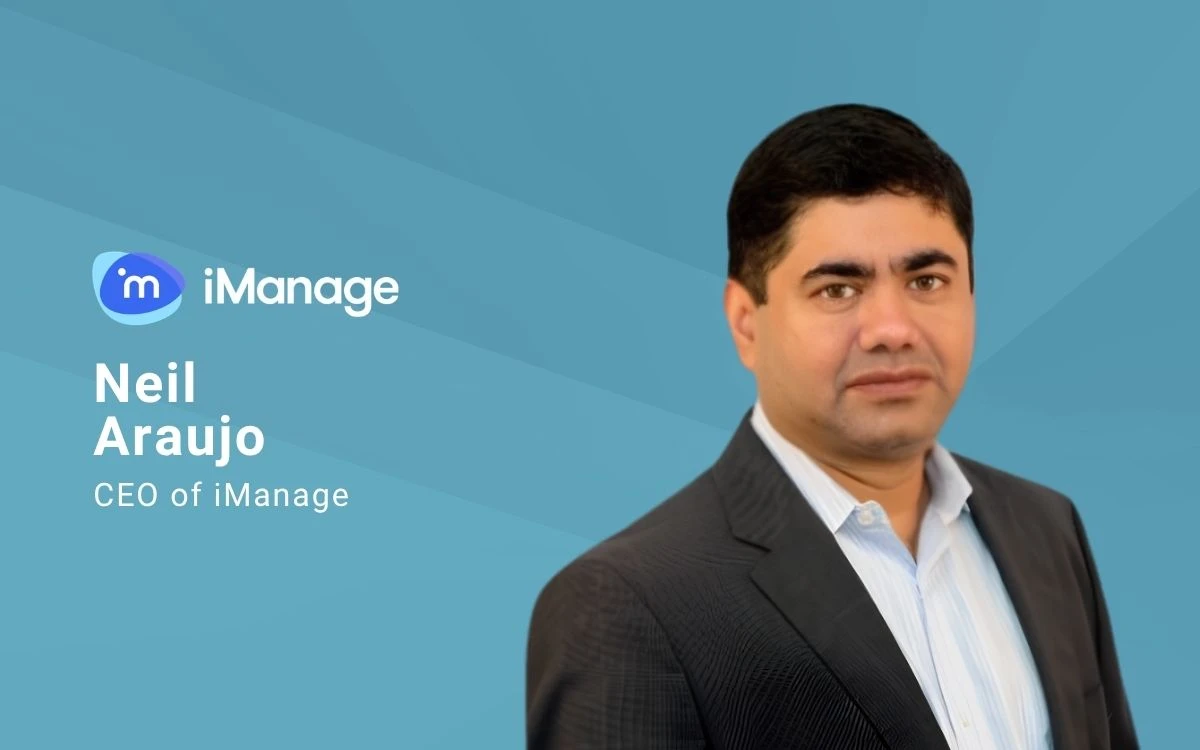
Neil Araujo is the co-founder and CEO of iManage. He has led the company from its early days as a document management pioneer to a global SaaS leader in AI-enabled knowledge work solutions.