








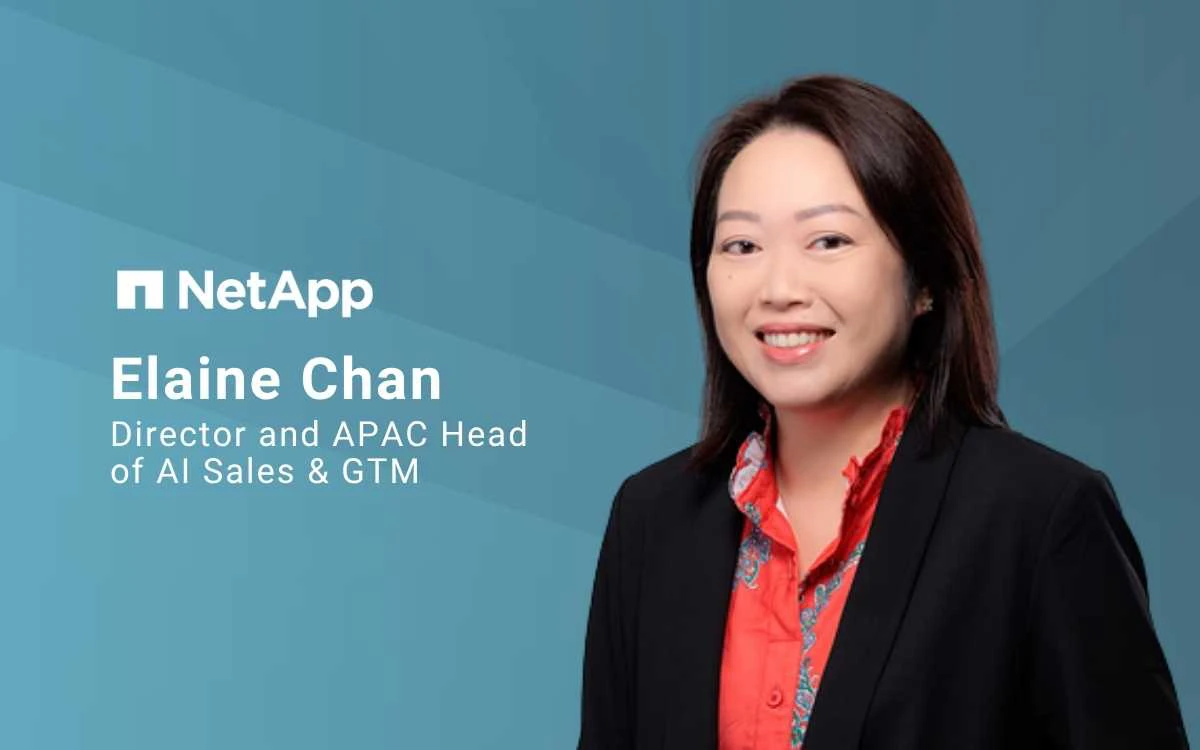
Elaine Chan, Director and APAC Head of AI Sales & GTM at NetApp
- Many organisations have experimented with AI pilots, but fewer have scaled them. What separates the enterprises that successfully move AI into production from those that stall?
The difference comes down to data readiness. AI success will not be determined by who has the biggest model or compute, but by who has the most unified, governed, and accessible data. Leading organisations invest early in unifying fragmented environments and establishing strong governance, so data is consistently available across teams and systems. This is what allows them to move quickly from experimentation to operationalisation.
Those that stall are often still dealing with disconnected systems and multiple copies of data, which makes it difficult to operationalise AI at scale. In reality, most AI initiatives don’t fail because of weak models, but because of weak data infrastructure.
At NetApp, we see this consistently across our APAC customers. The organisations moving faster are those that treat data infrastructure as a strategic priority from the outset. By ensuring their data is already AI-ready, compliant, and accessible wherever it needs to be, organisations that have started modernising data infrastructure are able to eliminate silos and move faster from pilots to production.
- Why do you believe modern data infrastructure will ultimately determine whether enterprises see real ROI from AI?
Most AI projects fail to deliver tangible ROI because they cannot scale effectively. Across APAC, this pressure to move beyond pilots and demonstrate measurable business value has never been greater—according to a KPMG Asia Pacific CEO Outlook 2025 report, 87 percent of APAC CEOs expect to see a return on their AI investments within three years.
Modern data infrastructure ensures data is not just stored, but continuously curated, governed, and made ready for AI. Below are five ways in which a modern, intelligent data infrastructure enables organisations to move from isolated experiments to scalable, repeatable outcomes:
- Break down data silos: By adopting a unified, logical view of the data, no matter where it’s stored – be it on premise, in the cloud or in a hybrid environment, organisations can give their AI models the high-quality data they need to perform and scale.
- Secure AI from the ground up: A modern data infrastructure ensures that security is built-in, and not bolted on. By applying a “secure-by-design” approach and a Zero Trust architecture, organisations can better safeguard and govern their data.
- Speed up data for real AI results: Traditional storage often chokes under the immense pressure to feed massive data to GPUs, quickly and flexibly. To scale, organisations require high-performance flash storage that provides not only speed, but also data mobility that moves data seamlessly from the edge to the cloud.
- Providing flexibility for AI success: True flexibility comes from a consistent data plane across multiple environments. It allows organisations to place data and workloads where they make most sense – based on cost, performance or compliance.
- Manage AI costs effectively: AI is resource-intensive, and unmanaged cloud costs can quickly escalate. With a modern data infrastructure, organisations can optimise AI performance with technologies such as deduplication and compression to reduce storage requirements.
AI ROI isn’t won by who has the fastest storage – it’s won by who can operationalise data at scale, across environments, with governance and cost control built in.
- What does “intelligent data infrastructure” look like in practice for organisations scaling AI today?
In practice, “intelligent data infrastructure” is less about infrastructure but more about an intelligent data platform – one that continuously transforms raw, distributed data into trusted, AI-ready data services wherever the business operates.
For organisations scaling AI, this means having a platform that can ingest, govern, protect, and move data seamlessly across on-prem, cloud and sovereign environments – while delivering the performance AI pipelines require, without creating new silos.
From NetApp’s perspective, intelligence comes to life through three key capabilities:
- Policy-driven automation – Data placement, tiering, replication, and retention are automated, reducing manual intervention and operational complexity.
- Built-in cyber resilience and governance – Sensitive data can be accessed and used securely and compliantly across different teams, with consistent enforcement of policies.
- Consistent data access for AI and Kubernetes workflows – AI data pipelines move from pilot to product in a repeatable, scalable way.
This is where NetApp differentiates itself from approaches primarily optimised for a single high-performance storage domain. NetApp is engineered as a unified data platform with mature enterprise data management, enabling customers to scale AI with speed, control and cost efficiency.
Ultimately, this allows organisations to move beyond POCs and pilots to deliver measurable, repeatable business outcomes from AI.
- With Agentic AI gaining attention across the industry, what foundations do enterprises need to put in place now to support more autonomous AI systems?
With agentic AI gaining attention, enterprises must recognise that these systems are not only generating insights but autonomously planning and executing actions – interacting with multiple tools, data sources, and APIs with minimal human intervention. While this significantly increased their value, it also expands their risk profiles.
Recent events, such as the March 2026 scrutiny of McKinsey’s internal AI platform, have highlighted how vulnerabilities in APIs and insufficient governance controls could potentially expose sensitive data at machine speed. This reinforces a critical reality: as AI becomes more autonomous, security gaps scale exponentially. Against this backdrop, what organisations need is not more infrastructure, but an intelligent data platform that embeds security, governance, and data control by design.
At NetApp, this means establishing a platform that unifies data across hybrid, multicloud, and sovereign environments, while consistently enforcing identity, access policies, and data lineage – ensuring agents only act on trusted, protected data. Crucially, capabilities such as policy-driven automation, cyber resilience, and real-time auditability must be intrinsic to the platform, not layered on after deployment.
This is where NetApp differentiates from solutions primarily focused on high-performance storage domains. By delivering a unified, enterprise-grade data platform with built-in governance and security, NetApp enables organisations to scale agentic AI safely – transforming autonomous systems from a potential risk vector into a controlled, production-ready source of business value.
Why is hybrid multicloud emerging as the default operating model for AI in APAC?
Hybrid multicloud is becoming the default for AI in APAC because organisations must balance three critical factors: data sovereignty, latency, and speed of innovation. This requires the ability to keep sensitive data local, while leveraging hyperscaler AI services – all while complying with increasingly stringent local regulations like Australia’s Privacy Act reforms, Singapore’s PDPA and others across the region.
At its core, this is not an infrastructure challenge – it is a data platform challenge. Enterprises need a platform that makes data portable, governed, and secure across on‑prem and cloud environments.
NetApp enables this through deep, first-party integration with leading hyperscalers, including AWS, Azure and Google Cloud. This allows organisations to operate seamlessly across on-premises and cloud environments, giving them the flexibility to run AI workloads anywhere, without compromising performance, compliance or control. For example, our recent collaboration with Google Cloud embeds NetApp’s secure-by-design storage systems into Google Distributed Cloud, enabling customers to power AI and sovereignty in private clouds.
More broadly, we’re seeing a shift toward more workload-driven strategies, where applications and data determine where workloads run. Hybrid multicloud is what enables that flexibility at scale.
As a result, hybrid cloud is no longer just an infrastructure preference – it’s becoming a strategic necessity for APAC enterprises that want to scale AI while maintaining compliance, performance, and cost efficiency.
- How does unifying data across hybrid multicloud environments help organisations run AI more effectively across different jurisdictions?
Unifying data allows organisations to bring AI to the data, rather than moving data across borders. This is critical in APAC, where data sovereignty requirements vary widely. A unified approach helps organisations stay compliant while avoiding duplication and fragmentation of data pipelines across regions.
In practice, AI projects often need tomove data closer to LLMs, burst into the cloud when on‑prem compute is constrained, and bring workloads back when needed, which requires more than infrastructure, it demands an intelligent data platform.
At NetApp, we enable this through a unified data platform that ensures data is portable, governed and securely accessible across environments, enabling seamless data mobility without duplication or re-architecting, allowing organisations to maintain a single source of truth while running AI workloads closer to where the data resides.
For example, we’re working with a neocloud provider in Singapore[OSY1] [CE2] that uses NetApp to manage data across its hybrid environment while complying with local data sovereignty requirements – without compromising on performance.
About Elaine Chan:
Elaine Chan is the Director and Asia Pacific Head of AI Sales and Go-to-Market (GTM) at NetApp, leading the company’s AI business strategy and driving the technology’s adoption across the region. She works closely with organisations to build intelligent data platforms that power AI-driven transformation for businesses.
With more than two decades of experience in the IT industry, Elaine has a proven track record in AI, cloud, and data management solutions. Before joining NetApp, she spearheaded AI and analytics sales as Head of Data Analytics for Google Cloud SEA. She has also held leadership roles at Denodo, Microsoft, and IBM.
Elaine is passionate about helping enterprises harness AI and data to unlock business value and bridge the gap between cutting-edge innovation and real-world applications. She holds a Bachelor of Science in Computer & Information Science from the National University of Singapore. She also earned a Graduate Diploma in Technopreneurship, Entrepreneurship, and Entrepreneurial Studies from the University of Washington.
About NetApp:
For more than three decades, NetApp has helped the world’s leading organisations navigate change – from the rise of enterprise storage to the intelligent era defined by data and AI. Today, NetApp is the Intelligent Data Infrastructure company, helping customers turn data into a catalyst for innovation, resilience, and growth.
At the heart of that infrastructure is the NetApp data platform – the unified, enterprise-grade, intelligent foundation that connects, protects, and activates data across every cloud, workload, and environment. Built on the proven power of NetApp ONTAP, our leading data management software and OS, and enhanced by automation through the AI Data Engine and AFX, it delivers observability, resilience, and intelligence at scale.
Disaggregated by design, the NetApp data platform separates storage, services, and control so enterprises can modernise faster, scale efficiently, and innovate without lock-in. As the only enterprise storage platform natively embedded in the world’s largest clouds, it gives organisations the freedom to run any workload anywhere with consistent performance, governance, and protection.
With NetApp, data is always ready – ready to defend against threats, ready to power AI, and ready to drive the next breakthrough. That’s why the world’s most forward-thinking enterprises trust NetApp to turn intelligence into advantage.