





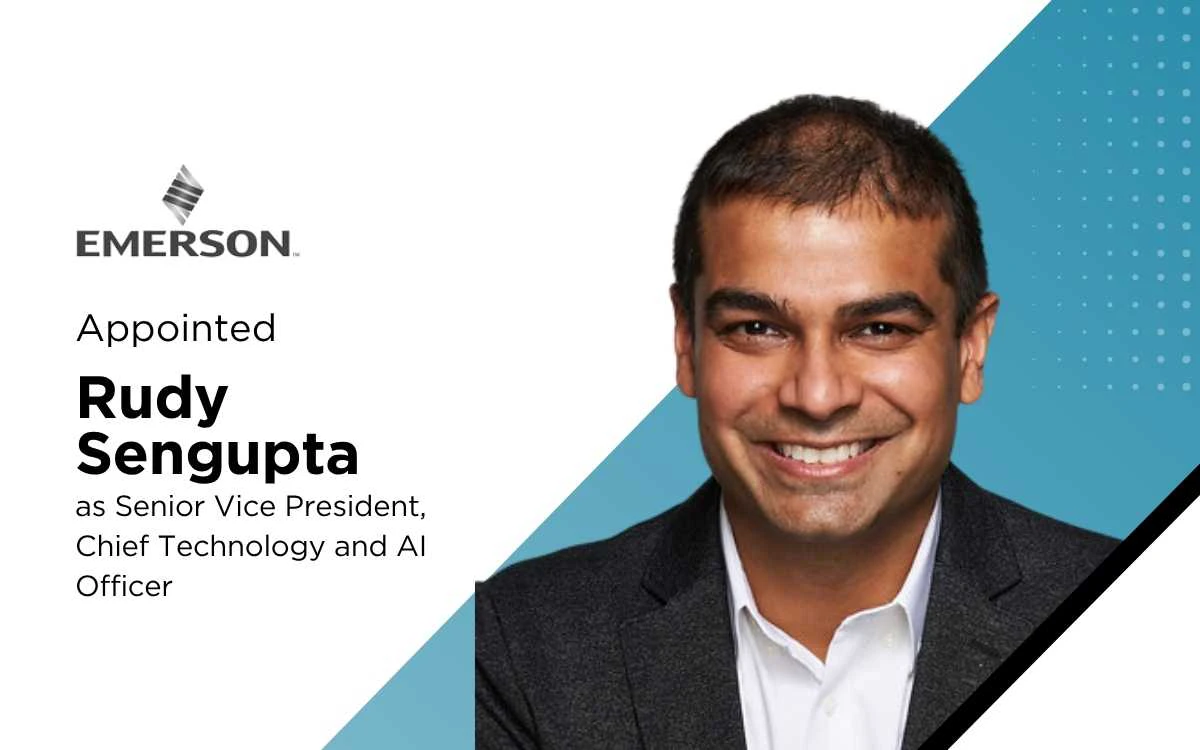
Industrial automation is entering an AI-driven transformation as manufacturers and infrastructure operators look to combine intelligent software, connected devices, and autonomous decision-making systems. Emerson is strengthening its AI strategy with the appointment of Rudy Sengupta as Senior Vice President, Chief Technology and AI Officer, placing artificial intelligence at the center of its next phase of industrial innovation.
Emerson Appoints Rudy Sengupta to Lead Enterprise AI Strategy
Industrial technology companies are increasingly moving beyond automation toward intelligent systems capable of analyzing data, optimizing operations, and supporting autonomous decision-making. Emerson’s latest executive appointment reflects this shift, with the company naming Rudy Sengupta as its new Senior Vice President, Chief Technology and AI Officer effective August 15, 2026.
Sengupta will join Emerson’s Office of the Chief Executive and oversee the company’s technology and artificial intelligence strategy across its portfolio of industrial software, automation systems, control technologies, and intelligent devices.
He succeeds Peter Zornio, who will retire on December 31, 2026, after more than 20 years with Emerson.
The appointment highlights Emerson’s broader effort to accelerate AI-enabled industrial automation, particularly as companies across manufacturing, energy, chemicals, and process industries seek greater efficiency through digital transformation.
AI Becomes Central to Industrial Automation Strategy
The industrial sector is undergoing a major technology transition. Traditional automation systems focused primarily on control and operational reliability. The next generation of industrial platforms is increasingly built around AI, cloud connectivity, analytics, and autonomous optimization.
Companies such as Microsoft, NVIDIA, and Amazon Web Services are expanding their industrial AI partnerships, while automation providers including Emerson, Siemens, Rockwell Automation, and Schneider Electric are integrating intelligence into industrial workflows.
Emerson’s strategy centers on developing AI-enabled automation capabilities across its technology stack, including its Enterprise Operations Platform, designed to help customers move toward autonomous operations.
The company’s focus reflects a growing market demand: industrial organizations want AI systems that can improve productivity while maintaining safety, reliability, and operational control.
Sengupta Brings Software and AI Experience From Test & Measurement
Sengupta joined Emerson through its acquisition of National Instruments (NI), where he developed experience across software-defined testing, engineering systems, product strategy, and operational leadership.
In his current position as Vice President and General Manager of Test and Analytics Software at Emerson Test & Measurement, Sengupta has focused on expanding software capabilities and integrating AI-driven features into testing and analytics workflows.
His work has helped shift the business from traditional test automation toward broader workflow management and data analytics solutions.
This background aligns with Emerson’s increasing emphasis on software as a growth driver. Industrial companies are investing heavily in software platforms that can collect operational data, identify patterns, and support predictive decision-making.
Enterprise AI Requires Industrial Data Intelligence
For industrial organizations, AI adoption presents a unique challenge: access to reliable operational data.
Unlike consumer AI applications, industrial AI systems must operate in environments where accuracy, security, and uptime are critical.
Manufacturing plants, energy facilities, and industrial infrastructure generate massive amounts of data from sensors, control systems, and connected equipment. Turning that data into actionable intelligence requires integration between hardware, software, analytics platforms, and AI models.
Research from Gartner and IDC has highlighted growing enterprise investment in AI platforms, industrial IoT, and automation technologies as organizations seek smarter operational models.
Emerson’s AI strategy aims to address this challenge by embedding intelligence into the systems customers already use.
Leadership Change Signals Long-Term AI Investment
The appointment of a dedicated Chief Technology and AI Officer reflects a broader organizational trend among large technology companies: creating executive leadership roles focused specifically on artificial intelligence.
As AI becomes a strategic capability rather than an experimental technology, enterprises are increasingly building centralized AI strategies that connect research, product development, infrastructure, and customer solutions.
Emerson CEO Lal Karsanbhai said Sengupta’s experience in software, AI, and recurring revenue growth will support the company’s long-term technology direction.
“Rudy’s leadership of our enterprise AI agenda and long-term technology direction will be instrumental in accelerating innovation across Emerson,” Karsanbhai said.
For Emerson, the move represents an effort to strengthen its position in intelligent automation as industrial customers increasingly demand systems that can operate with greater autonomy.
The Future of Industrial AI
The next generation of industrial automation will likely be defined by collaboration between machines, software platforms, and AI systems.
AI-enabled automation can help companies improve asset performance, reduce downtime, optimize production processes, and make faster operational decisions.
However, successful industrial AI adoption will require more than advanced algorithms. Companies will need secure infrastructure, domain expertise, and technology platforms capable of operating in complex real-world environments.
Emerson’s leadership transition reflects this changing landscape. By placing AI strategy under dedicated executive leadership, the company is signaling that artificial intelligence will play a central role in the future of industrial operations.
Market Landscape
The industrial AI market is evolving around several major trends:
- Autonomous operations: Manufacturers are using AI to optimize processes with limited human intervention.
- Industrial software growth: Companies are shifting from hardware-centric models toward software-driven platforms.
- AI-powered predictive maintenance: Organizations are using machine learning to anticipate equipment failures.
- Connected industrial ecosystems: Sensors, cloud platforms, and intelligent devices are becoming integrated operational systems.
Major industrial technology providers including Emerson, Siemens, Rockwell Automation, Schneider Electric, and Honeywell are competing to provide AI-enabled automation solutions.
Top Insights
- Emerson appoints Rudy Sengupta as Chief Technology and AI Officer to accelerate enterprise AI and automation innovation.
- The leadership change reflects growing demand for AI-enabled industrial software and autonomous operations.
- Sengupta brings experience in software-defined testing, analytics, and AI integration from Emerson’s Test & Measurement business.
- Industrial companies are investing in AI platforms that transform operational data into actionable intelligence.
- Emerson’s AI strategy focuses on combining software, automation, and intelligent devices for enterprise customers.
Power Tomorrow’s Intelligence — Build It with TechEdgeAI