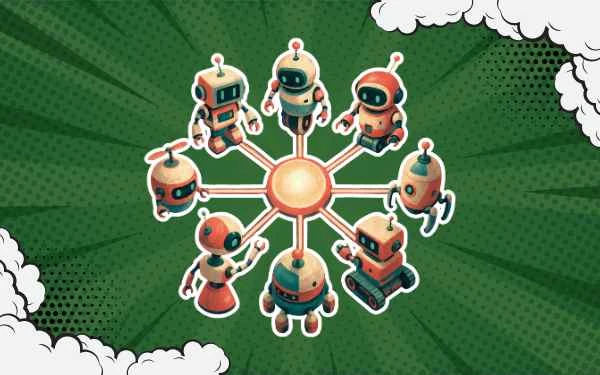










Access to artificial intelligence is no longer the biggest obstacle for many professionals and small businesses. Knowing how to use AI consistently—and turning individual experiments into repeatable workflows—has become the harder problem. AI Advantage, the AI education platform co-founded by Dean Graziosi and Tony Robbins, is building its training model around community learning, combining courses with peer examples and shared implementations.
The AI industry’s attention has largely shifted from whether businesses should use artificial intelligence to how employees can use it effectively.
That second question is proving harder.
Generative AI tools are widely available, but access does not automatically translate into confidence or productivity. Professionals may know that tools such as ChatGPT, Claude or Gemini can automate parts of their work without knowing which tasks to delegate, how to construct reliable workflows or how to evaluate the resulting output.
AI Advantage is betting that one answer is not another library of tutorials. It is a community.
The AI education platform, co-founded by Dean Graziosi and Tony Robbins, has structured its programs around the idea that people learn AI more effectively when they can see how others apply the technology to comparable problems.
Its portfolio includes the AI Advantage Bootcamp, AI Advantage Club and AI Mastery. Rather than treating course material as a fixed sequence of lessons, the programs encourage members to share implementations, prompts and workflows.
That creates a potentially important feedback loop.
A member who discovers an effective way to automate a repetitive task can document the process. Another participant can adapt it to a different business. The resulting implementation can then become part of the collective knowledge base.
In theory, this changes AI education from a one-to-one instructor model into a network effect.
The approach is particularly relevant for nontechnical users. Much of the current AI ecosystem is designed around increasingly sophisticated capabilities—agents, APIs, model orchestration and automation frameworks—that can make the technology appear more complicated to someone who simply wants to reduce the time spent on administrative work.
AI Advantage is targeting that gap.
Its audience includes entrepreneurs, small-business owners and nontechnical professionals who want to apply AI without becoming programmers.
That market is becoming increasingly important as organizations move beyond experimentation.
McKinsey’s latest global AI research has found that generative AI adoption is now widespread across organizations, but many companies continue to struggle to translate experimentation into significant enterprise-level impact. The gap is increasingly one of workflow redesign, governance and employee adoption rather than simply model access.
For smaller businesses, the challenge can be even more practical.
A company may not have an AI engineering team or dedicated transformation office. The person implementing AI might be the owner, marketer, salesperson or operations manager. Training therefore needs to be directly connected to the person’s existing work.
That is where community-based learning can have an advantage.
Instead of presenting prompting as an abstract technical skill, participants can exchange examples based on actual workflows: drafting customer communications, summarizing documents, building research processes, creating marketing assets or automating repetitive administrative tasks.
The model also changes the role of the instructor.
Igor Pogany, Head of AI Education at AI Advantage, describes his role as making ideas simple enough that members can teach one another. That reflects a broader trend in professional education, where peer-generated knowledge can supplement formal curriculum.
The curriculum itself is also intended to evolve.
AI Advantage says questions raised by its community and the workflows members create feed back into the programs. Current areas of focus include personalized AI systems that handle recurring tasks, practical prompting techniques and productivity applications developed by participants.
That adaptability is important in AI education because the underlying technology changes faster than traditional course-development cycles.
A course built around a specific model interface can become outdated quickly. A course centered on transferable concepts—how to identify an automation opportunity, structure instructions, evaluate outputs and build repeatable workflows—can remain useful as individual AI products change.
AI Advantage says its programs have produced measurable improvements in participant confidence. According to the company, average AI confidence scores increase from 4.1 to 8.1 out of 10 within 30 days, while more than 70% of participants report reclaiming at least 15 hours per week after completing a program.
Those figures are company-reported and should not be interpreted as independent evidence of productivity gains.
The distinction matters because AI education is becoming a crowded market.
Major technology companies including Microsoft, Google, Amazon and Salesforce are producing their own AI training resources, while universities, online learning platforms and specialist consultancies are developing programs around generative AI and automation.
The differentiator for AI Advantage is therefore less likely to be access to information and more likely to be its community model.
The company says participants span more than 150 countries, creating a geographically diverse pool of use cases.
That diversity can be useful when the technology is applied to business processes that vary considerably by industry, geography and company size. A workflow developed by a consultant may reveal an approach that a small retailer, agency or professional-services firm can adapt.
But community-driven learning also brings challenges.
Shared workflows need to be evaluated for accuracy, security and suitability before being adopted in business environments. AI-generated outputs can contain errors, and an automation that works for one organization may create compliance or privacy problems for another.
For enterprises, that means AI literacy cannot stop at prompting.
Employees need to understand data governance, human oversight, model limitations and the risks associated with autonomous AI systems.
AI Advantage is primarily positioned toward individuals and smaller organizations, but its approach highlights a broader lesson for enterprise AI adoption: skills spread through organizations when employees can see practical examples and learn from peers, not simply when they are given access to a new tool.
As AI becomes embedded in everyday workflows, the competitive advantage may increasingly belong to organizations that can turn individual experimentation into shared institutional knowledge.
That is the problem AI Advantage is attempting to solve with community at the center of its education model.
Market Landscape
The AI education market is evolving alongside enterprise adoption.
Traditional technology training focused on software features and technical certification. Generative AI is creating demand for a different category of learning: AI literacy, workflow automation, prompting, agent management and practical implementation.
Major technology ecosystems are contributing to that shift:
- Microsoft is embedding Copilot across workplace applications and developing AI-skilling initiatives.
- Google is expanding Gemini across productivity and enterprise workflows.
- Amazon Web Services is building AI training and cloud-skilling programs for developers and organizations.
- Salesforce is focusing heavily on AI agents and AI-powered customer workflows.
- OpenAI and other model providers are lowering the technical barrier to building AI-powered applications.
Against that backdrop, AI Advantage’s community-first model targets a different part of the market: people who need to understand how AI fits into their actual jobs, rather than how to build AI systems.
The bigger industry challenge is adoption depth. Giving employees access to AI tools is relatively easy. Creating repeatable, governed workflows that generate measurable productivity improvements is considerably harder.
That makes AI literacy, peer learning and change management increasingly important components of enterprise AI strategy.
Top Insights
- AI Advantage is building AI education around community learning, allowing professionals to share prompts, workflows and practical implementations instead of learning in isolation.
- The platform targets nontechnical professionals and small-business owners who want practical AI automation without requiring programming expertise or dedicated technical teams.
- Company-reported data shows participant AI confidence rising from 4.1 to 8.1 out of 10 within 30 days, though results are independently unverified.
- More than 70% of participants reportedly reclaim at least 15 hours weekly, highlighting the platform’s emphasis on measurable workflow automation rather than theory.
- The community model reflects a broader enterprise trend: AI adoption increasingly depends on workforce skills, peer knowledge-sharing, governance and practical workflow redesign.
Power Tomorrow’s Intelligence — Build It with TechEdgeAI