






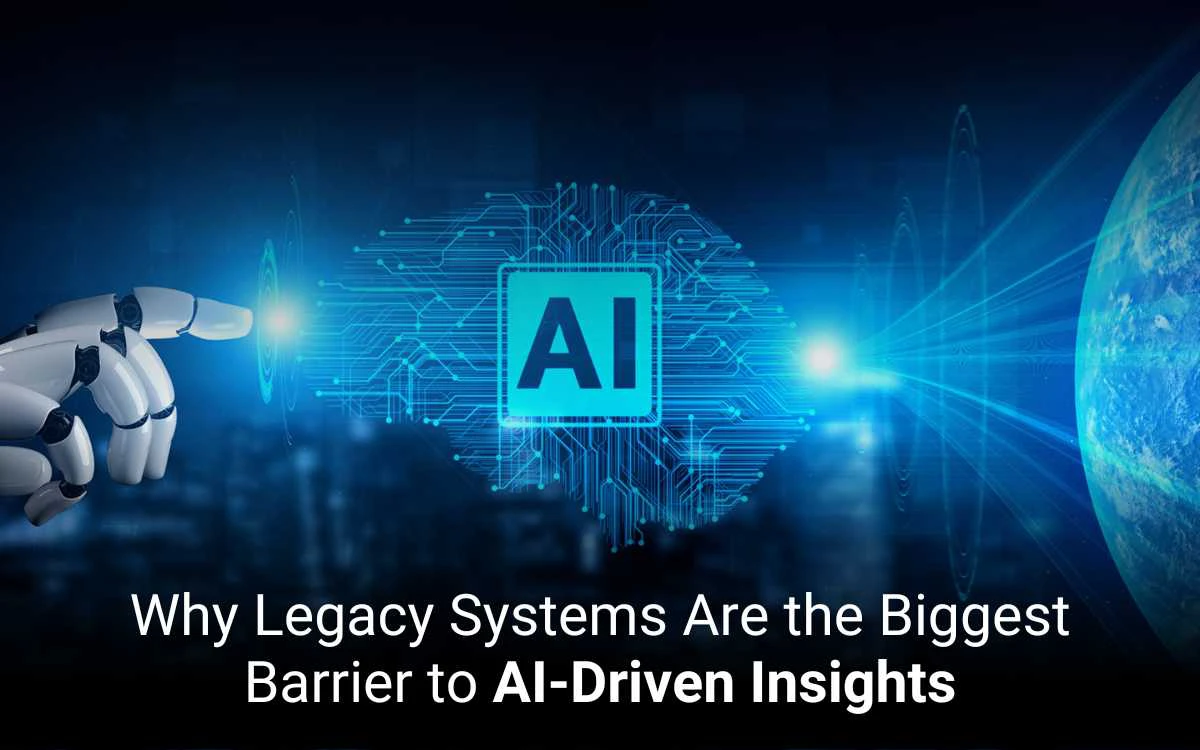
An enterprise has ERP, CRM, and reporting tools, but they were never designed for the scale and speed of today’s business environment. Teams spend hours pulling reports, consolidating spreadsheets, and analyzing data only to realize that market conditions have already shifted. It prevents leaders from seeing opportunities in real-time.
The need for AI-driven insights in legacy systems is critical. For example, a manufacturing company is relying on an old ERP system. While it records production data, it cannot analyze performance trends or predict equipment failure. AI-enabled predictive analytics with operational data can minimize downtime and reduce costs.
This article will discuss the importance of AI-driven insights and why they need to be implemented in legacy systems.
The Key to Using AI Data Insights for Digital Transformation
Here’s why you need to implement AI data insights.
1. Shift from Data Overload to Actionable Intelligence
Legacy dashboards often highlight “what happened,” but AI-Driven Insights show “what’s next” and “what to do about it.”
For example, a SaaS provider using AI Insights can predict customer churn before it happens and trigger retention campaigns.
2. Bridge Siloed Data Across Functions
Legacy systems often store data in departmental silos. By applying AI-Driven Insights, organizations can integrate data across sales, marketing, finance, and operations.
Consider a logistics company. AI Insights can connect fleet performance data with financial metrics, allowing for optimization for both cost efficiency and delivery speed.
3. Enable Predictive and Prescriptive Decisions
True transformation happens when leaders adopt predictive and prescriptive intelligence. A manufacturing firm, for instance, can use AI-Driven Insights to forecast equipment failures, schedule predictive maintenance, and minimize downtime.
4. Accelerate Innovation and Agility
AI Insights provide early signals of shifting market dynamics, enabling leadership to pivot faster. For instance, a chemicals supplier can leverage AI-Driven Insights to detect emerging demand patterns in specific industries and redirect production capacity.
Top 3 Barriers Legacy Systems Create for AI Systems
Here are the main barriers hindering AI systems.
1. Data Silos and Poor Accessibility
Legacy systems store data in databases across different functions, making integration nearly impossible. Without unified data, AI Insights cannot uncover patterns. For example, a manufacturing company may have its supply chain data in one system and customer demand data in another. The lack of integration prevents AI from forecasting demand fluctuations.
2. Outdated Infrastructure and Incompatibility
Legacy platforms lack real-time processing capabilities, advanced APIs, and cloud compatibility. This creates additional costs for custom integration. Consider a logistics provider still running an old ERP system. When attempting to apply AI-Driven Insights for route optimization, the system fails to process live traffic and fuel cost data, resulting in static reports that lead to inefficiencies.
3. High Operational Costs
Maintaining legacy systems consumes significant IT budgets, leaving fewer resources for innovation. Embedding AI across workflows becomes an expensive process. For example, a financial services firm may want to implement AI-driven fraud detection. But with its legacy systems, every enhancement requires costly resources and extensive manual coding.
Common Challenges to AI Adoption and How to Overcome Them
Below are the common barriers to AI adoption.
1. Poor Data Quality and Governance
Challenge: AI systems are only as good as the data they consume. Incomplete or duplicate data can lead to inaccurate AI-Driven Insights.
Solution: Establish data governance frameworks, with ownership, accountability, and automated cleansing mechanisms.
Example: A SaaS firm introduced AI data quality checks, reducing duplication in CRM records and improving lead scoring accuracy.
2. Legacy System Limitations
Challenge: Outdated IT infrastructure cannot support AI workloads, real-time analytics, or cloud integration.
Solution: Modernize infrastructure by adopting a hybrid cloud, enabling AI tools to integrate into existing workflows seamlessly.
Example: A financial services company moved its risk analytics from on-premise servers to the cloud, enabling the detection in near real-time.
3. Lack of AI Talent and Skills
Challenge: Even with the right tools, organizations often lack the data scientists and domain experts needed to extract value from AI Insights.
Solution: Build blended teams that combine in-house expertise with external partnerships. Upskill employees with AI literacy programs.
Example: A company partnered with an AI consultancy to train its operations team, enabling them to interpret predictive maintenance models.
4. Cultural Resistance to Change
Challenge: Employees may perceive AI as a threat to jobs, while leaders may distrust algorithmic decision-making.
Solution: Foster a culture of trust by leveraging AI as a key enabler. Use transparent AI models and demonstrate quick wins that benefit employees.
Example: A professional services firm introduced AI-driven proposal generation, saving consultants hours of manual work.
5. High Costs and Unclear ROI
Challenge: AI adoption involves significant upfront investment in infrastructure, talent, and training. Without a clear ROI, leadership hesitates to commit.
Solution: Start with pilot projects tied to measurable business outcomes such as revenue growth, cost reduction, or efficiency improvements.
Example: A manufacturing company piloted AI-Driven Insights for energy optimization in one plant, achieving a cost reduction before rolling it out enterprise-wide.
6. Ethical and Compliance Concerns
Challenge: Regulatory requirements and ethical concerns about bias, privacy, and transparency often stall AI initiatives.
Solution: Implement responsible AI frameworks in AI models. Align compliance teams early in the process.
Example: A healthcare supplier used explainable AI to ensure regulatory compliance while personalizing supply chains for hospitals.
Conclusion
Organizations that cling to legacy systems will lag, while competitors armed with AI-driven insights will take the lead. Begin by identifying areas where AI can deliver immediate value, modernize your data foundations, and establish a clear roadmap for informed decision-making. The sooner you break free from the constraints of legacy systems, the faster you can use AI Insights to lead in your industry.
Break free from legacy barriers. Unlock AI insights today!