









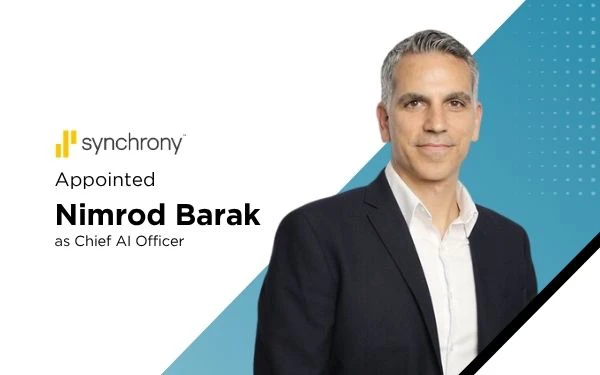
Synchrony is giving its artificial intelligence program a dedicated executive owner as financial institutions move from AI experimentation toward enterprise-wide deployment. The consumer financial services company has appointed Nimrod Barak as Chief AI Officer, effective June 30, 2026, putting him in charge of the company’s AI strategy, governance and implementation as it expands agentic AI and automation across its operations.
The appointment signals a familiar next step for large financial institutions: AI is moving from a technology initiative to an enterprise operating priority.
Barak will oversee Synchrony’s development and deployment of AI capabilities across products, operations and decision-making. His remit includes enterprise AI strategy and governance, agentic AI, intelligent automation and responsible AI practices.
Synchrony says adoption is already widespread. Nearly 100% of its professional workforce uses AI tools, including its internal Synchrony GPT platform, which the company has made available since 2024. The company also says 90% of employees trust Synchrony to use AI fairly, ethically and responsibly.
Those figures are notable because employee adoption is becoming one of the harder problems in enterprise AI. Buying access to models is relatively straightforward; getting thousands of employees to incorporate AI into daily workflows while maintaining appropriate controls is considerably more difficult.
The appointment also comes as financial services companies increasingly experiment with AI agents capable of performing multi-step tasks rather than simply generating text or summarizing information.
Synchrony says its next phase will include agentic commerce and intelligent automation. In practical terms, that could encompass AI systems assisting customer service, employee workflows, financial operations, marketing, software development and partner interactions.
The financial sector presents a particularly demanding environment for that transition. AI systems handling customer or financial information must operate within established requirements for privacy, security, model risk, compliance and human oversight.
A chief AI officer therefore has a broader responsibility than a traditional head of machine learning. The role sits at the intersection of technology strategy, data governance, business transformation and risk management.
From AI experimentation to operating model
Synchrony’s decision reflects a broader change in corporate AI leadership.
Early enterprise generative AI programs were often led by CIOs, CTOs, data-science organizations or small innovation teams. As AI becomes embedded into business processes, some companies are creating dedicated leadership roles to coordinate model selection, infrastructure, governance, workforce adoption and use-case prioritization.
That shift is particularly visible in banking and financial services, where institutions have substantial amounts of structured data and highly repeatable workflows but also face strict regulatory expectations.
The challenge is not necessarily finding use cases. Customer support, fraud detection, underwriting, software development, employee productivity and document processing all present potential opportunities.
The harder question is how those use cases should be governed when AI moves from an assistant that recommends an action to an agent that can execute one.
Synchrony’s emphasis on governance alongside deployment is therefore significant. Barak will oversee both AI execution and the framework governing how AI is used across the organization.
That approach mirrors the direction taken by major technology vendors. Microsoft, Google, Amazon Web Services and Salesforce are all developing enterprise AI-agent platforms designed to move beyond conversational assistants toward systems that can interact with business applications and workflows.
For financial institutions, however, adopting an agent does not eliminate the need for traditional controls. It can increase it.
An AI agent with access to customer records, internal applications or transaction workflows creates a larger potential attack and failure surface than a standalone chatbot. Organizations will need to establish permissions, monitor actions, maintain audit trails and determine when human approval is required.
Barak brings financial-services AI experience
Barak joins Synchrony after serving as Managing Director and Head of AI Center of Excellence and Emerging Technologies at Citi.
His background spans more than two decades of engineering, data and AI leadership. At Citi, his work placed him within one of the world’s largest financial institutions at a time when banks were accelerating investment in generative AI and automation.
That experience could be particularly relevant to Synchrony’s strategy because financial-services AI has to balance innovation with institutional controls.
Synchrony is not starting from scratch. Its internal AI adoption program has already established a workforce base, while the new appointment creates a centralized executive role for scaling those capabilities.
The next phase is likely to be judged less by the number of AI tools employees can access and more by whether AI produces measurable improvements in customer experience, operating efficiency and business growth.
Agentic commerce becomes the next frontier
Synchrony’s reference to agentic commerce points toward a larger change in consumer finance.
AI agents could eventually help consumers discover products, compare offers, manage purchases or interact with financial-service providers. On the business side, agents could automate partner interactions, personalize customer experiences and coordinate multiple steps of a transaction.
That creates an opportunity for Synchrony, whose business spans consumer financing and relationships with retail and other commercial partners.
But agentic commerce also raises questions about identity, authorization and consumer consent. If an AI agent acts on behalf of a consumer, financial institutions need to know who authorized the action, what the agent was permitted to do and how the institution can verify the transaction.
Those issues will become more important as AI moves from recommendation engines into systems that can initiate or complete transactions.
What it means for enterprise AI teams
Synchrony’s appointment is another indication that enterprises are entering a more operational phase of AI adoption.
The first wave focused on giving employees copilots and generative AI assistants. The next wave is likely to focus on integrating AI into core workflows and allowing agents to take controlled actions.
For technology leaders, that means AI strategy increasingly needs to cover three layers at once: models and infrastructure, business applications, and governance.
Synchrony’s decision to place all three under a chief AI officer reflects that convergence.
The company’s high reported employee adoption provides a useful foundation, but adoption alone will not establish whether its AI strategy succeeds. The more meaningful test will be whether Synchrony can turn broad employee usage into reliable automation, better customer outcomes and new business capabilities without weakening the trust and controls required in consumer finance.
Barak’s appointment puts that challenge squarely on the executive agenda.
Market Landscape
Financial institutions are moving toward an AI operating model in which generative AI, predictive machine learning and agentic automation work across customer service, software engineering, fraud, risk and back-office operations.
McKinsey estimates that generative AI could create $200 billion to $340 billion in annual value for the banking industry, largely through productivity improvements and revenue opportunities. (mckinsey.com)
The opportunity is substantial, but financial services also has unusually high requirements for explainability, security, privacy and human oversight. That makes governance a core component of enterprise AI architecture rather than a separate compliance exercise.
Synchrony’s nearly universal professional-workforce adoption suggests the company is attempting to establish AI familiarity before expanding toward more autonomous systems. The move from employee-facing copilots to agentic workflows will require stronger controls around permissions, data access, monitoring and accountability.
The competitive landscape includes banks developing proprietary AI platforms as well as technology providers such as Microsoft, Google, AWS and Salesforce, which are selling enterprise AI agents and orchestration infrastructure across industries.
Top Insights
- Synchrony appointed Nimrod Barak as Chief AI Officer, consolidating enterprise AI strategy, governance and execution as financial services moves toward agentic automation.
- Nearly 100% of Synchrony’s professional workforce reportedly uses AI tools, giving the company an established employee base for expanding enterprise AI applications.
- Barak’s Citi AI leadership experience brings financial-services expertise to Synchrony’s efforts around responsible AI, intelligent automation and agentic commerce.
- The appointment reflects a broader shift from AI copilots toward autonomous enterprise agents that can execute controlled tasks across applications, data and workflows.
- Financial institutions adopting agentic AI must balance productivity gains with permissions, auditability, privacy, security, regulatory compliance and customer trust.
Power Tomorrow’s Intelligence — Build It with TechEdgeAI