





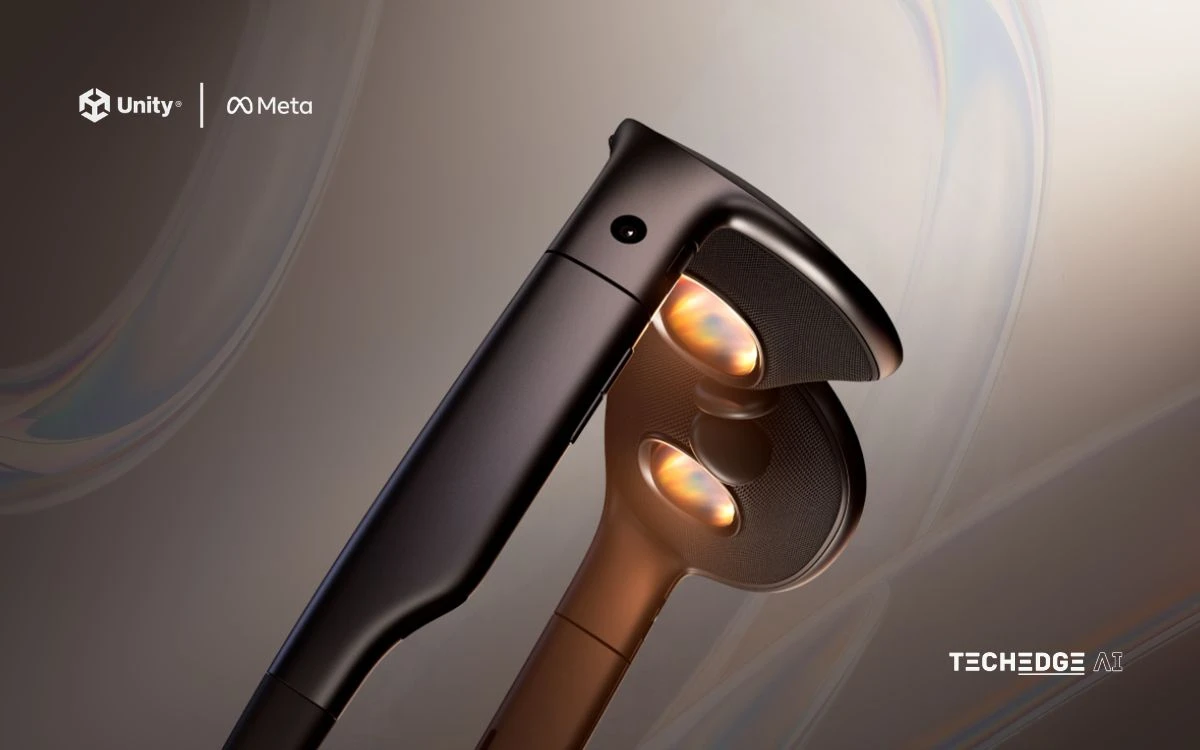
Meta’s newly unveiled Meta VR Glasses have officially shifted the timeline for spatial computing, following a landmark announcement at Meta Connect. This device is not a prototype. The device marks a shift, for developers. Unity announced that they will support the hardware from day one. Unity started a race to build ecosystems before the device launches in spring 2027.
This coordinated rollout signals a mature phase for the industry. Rather than launching hardware into a software vacuum, Meta and Unity are aligning tech pipelines to guarantee a robust library on day one.
According to Unity, “studios behind launch titles Cardmada™, Dragon Grove, Phoenix Wright™: Ace Attorney™ Dual Destinies VR, Dice Throne Digital, Supernatural, Two Point Hospital – Mixed Reality Edition, and Story of Seasons are already building for VR Glasses with Unity.” (Unity)
The core problem plaguing virtual reality has long been weight and thermal discomfort, a hurdle Meta overcomes by decoupling the device’s core components. By engineering a lightweight 100-gram VR glasses paired with a stunning 5K Infinite Display, Meta shifts the interaction paradigm. The interface responds dynamically to hands, eyes, and voice commands controlled by Meta AI. Consequently, software developers must now look beyond plastic controllers and pivot toward completely gestural, frictionless spatial user experiences.
By offloading the heavy computational hardware and power supply into a standalone, pocket-sized “compute puck” connected via a thin tether.
This modular approach alters how software behaves. By utilizing ultra-compact pancake lenses and removing thermal bottlenecks from the user’s face, developers can target longer session times and continuous media playback.
Unity’s integration acts as the crucial bridge for the developer community. Rather than forcing creators to learn an entirely new proprietary architecture, Unity’s Day-one engine support provides native building tools through standard OpenXR, the XR Interaction Toolkit, and XR Hands. This seamless transition is already proving successful on the ground.
“Developing for Meta VR Glasses has been a smooth and straightforward experience. The workflow feels very familiar to Quest 3, allowing us to build on the tools and experience we already have,“ said Miguel Gonçalves, Lead Game Designer at Soul Assembly, who worked on Two Point Hospital – Mixed Reality Edition. (Unity)
Technically, Unity enables developers to optimize performance through specialized rendering techniques like quad views rendering and native eye tracking. Because the hardware is powered by Qualcomm’s latest spatial processing architecture, Unity’s engine handles the heavy lifting of multi-screen workspace rendering, fast scene load times, and high-efficiency battery management without sacrificing visual fidelity. It allows studios to port, test, and iterate complex spatial geometry months before a consumer ever touches the glass.
Meta’s role in this launch is clear that they are transitioning from a hardware manufacturer to an ambient computing platform provider. By utilizing the same underlying Meta Horizon OS found on the Quest ecosystem, Meta minimizes technical friction. Creators can use the exact same SDKs and skills they already possess, allowing older Quest games to remain playable via backward compatibility.
Meta is intentionally establishing the VR Glasses as an all-in-one entertainment console, private workspace, and cinematic powerhouse securing media partnerships to offer premium immersive content at launch.
The simultaneous launch of the Meta VR Glasses and Unity’s Day‑one developer support marks an important step, in the growth of consumer XR. For years the industry has been stuck in a “chicken‑and‑egg” problem. Hardware cannot become popular without software and developers are reluctant to create software when there is no strong user base. This new launch helps break that cycle and drives consumer XR forward.
By providing engine access nearly half a year before retail shipping, Meta and Unity are eliminating this friction. This coordinated launch model sets a new standard for how computing platforms must be introduced to the market.