









1. SMEs, MNCs, government — who is moving fastest on meaningful deployment?
Everyone is adopting AI. Buying copilots, running pilots, that is the easy part. Deploying is different. I mean a model running in production, with someone on your side who owns it. That is rarer, and it is the only measure I care about.
If you count projects, the multinationals lead. Of the 66 generative-AI projects we delivered in one recent national programme, 22 went to multinationals, 19 to SMEs, 14 to government agencies, and roughly six in ten of the total reached verified deployment. But counting projects tells you who adopted AI. It does not tell you who moved the needle. For speed, watch the SME. The owner decides on Friday and starts on Monday. No steering committee, no procurement cycle. HSC Pipeline, an engineering SME, cut an engineering-answers process from days to minutes, because the managing director refused to let it stall. At an SME, budget can be the constraint but the boss’s attention is critical to the success of the AI project.
The multinationals have the most data and the most pilots, and the most people who must sign off, so their pilots live long lives. The committed ones are different. Continental started with five projects with us and upgraded to ten. Government sits in between. When an agency commits, it commits with scale, and it moves faster than people expect, because the national strategy has already won the argument that is still being fought inside most boardrooms. One agency we worked with used to review one percent of its customer-service conversations by hand. Today the system reads one hundred percent. SCDF put a Singlish speech-to-text system in front of its emergency call dispatchers.
So, on pace: SME first, government second, MNC third.
Now let me be fair to the SME, because most of them cannot reach the starting line. When we started, eight out of ten companies that came to us were not ready. No engineering team to take over the model, no usable data, or no budget. Deployment has a minimum capability floor, and most SMEs are below it or what we call not AI Ready. The ones that clear the floor are the fastest deployers in the country. That floor is why we built the AI Readiness Index (AIRI) in 2019 and the literacy programmes like AI For Everyone and AI For SMEs around the SME. For most of them, the target is not an AI team. It is AI Ready: using these tools with judgment, every day.
2. What convinced you that plus-skilling the existing workforce is the right lever?
In 2017 I put out our first advertisement for AI engineers. Over three hundred resumes came in. Ten were Singaporeans. I only managed to hire one, so I had to be creative to build my AI team. And I could not out-pay Google and Microsoft for computer-science graduates, so we went where they were not looking: accountants, biologists, lawyers, engineers, people who already knew a field, were able to code with python and importantly were already learning AI/ML on their own out of curiosity, interest or passion. The AI Apprenticeship Programme (AIAP) was launched in 2018. That is the Blue Ocean move.
The market has now voted on the idea. We have trained more than five hundred AI engineers through AIAP. Eighty percent came without a computer-science degree. Today around fifty percent will have a job offer before the programme ends and more than ninety percent will be working in an AI role within three months of graduation.
Plus-skilling keeps the moat (the domain experience) and adds the capability on top of it. Re-skilling abandons the moat and competes with fresh graduates at the keyboard. That is the wrong contest. This is even more true today, where agentic coding tools can do a lot of the heavy lifting and domain expertise is increasingly becoming the differentiator in project success and hiring.
In a way, we were already training for the hottest job today – the Forward Deployed Engineer – since 2018. The best FDEs are not only technically skilled, but can understand the domain he or she is deployed into quickly.
3. What does an AI adoption path look like for an SME with limited technical resources and no AI team?
It starts with the boss, not the technology. Step one: take the AI Readiness Index (AIRI) yourself. It is free, it takes about ten minutes, and it lives at airihub.org. It tells you your level before a vendor tells you what to buy. Most SMEs should aim for AI Ready, level two. That means using AI well in daily work. It does not mean building models. Step two: get the team literate. AI For Everyone is free, and more than three hundred thousand people have taken it. Step three: pick one problem. Not five. One, with a ROI you can defend in your annual report. Then run one small project, three to six months, a small team, with deployment intended from day one. We have a specific programme for the SMEs, the LLM Application Developer Programme (LADP) where we train and mentor the SMEs’ team to design, build and own their own LLM-powered project.
Two rules keep you safe. Buy before you build: if a commodity tool already solves the problem, buy it, and spend your energy on adoption. And never let the vendor keep the knowledge: your people work inside the project, and the handover trains your champion to run it.
What an SME does not need is an AI team. It needs AI-literate leadership, one internal champion, clean data for one problem, and a first win small enough to survive being wrong.
4. What is the AIAP model, and what does it produce that a degree or a short course does not?
Nine months, full-time, and nobody touches a toy dataset. Three months of deep-skilling, then the real thing: an industry project with a paying sponsor, demanding stakeholders, messy data, requirements that change on you. A team of apprentices delivers it, guided by mentors who graduated from the same programme, because the best person to mentor you is someone who has been through it. The deliverable is held to a production bar. A containerised model behind an API, with documentation, handed to a sponsor who must deploy it.
Selection ignores degrees. Pass the technical assessment and the interview, and show the attitude. That is all. We are probably the most aggressive skills-based “hiring” organisation in Singapore.
What does that produce that a degree does not? Judgment. The ability to evaluate output, scope the right problem, and answer for what ships. At the closing meeting of one project, the sponsor’s data scientist said, “We can move into production next week.” That comment struck me then, and it still does. A degree builds a robust academic foundation and that is important. One archetype, and a valuable one. A bootcamp builds familiarity with algorithms in a notebook, and employers know it; they dismiss those certificates because the grant economics reward passing, not competence. A bootcamp is a few golf lessons. It does not make a golf pro. The proof is in the placement: ninety percent placed within three months, fifty percent hired before graduation.
5. Where are the gaps still holding back local AI talent development?
The talent is there. The employers are the gap. The national target is fifteen thousand AI practitioners, and in eight years we have trained more than five hundred engineers ourselves. The arithmetic is blunt, and we worked it out in 2019: ten organisations, each running an apprenticeship at one hundred a year, add five thousand engineers in five years. We offered to license the entire method. Most said no, and took the easier routes: you train, we hire; run a hackathon; hire foreigners; or do nothing and complain that Singaporean AI talent cannot be found. Growing your own timber works. We are the proof. But it asks an organisation to invest to train the talent, and most do not.
Three more gaps sit behind that one. The signal gap: subsidised courses reward passing, not competence, so the certificate market is poisoned, and employers dismiss qualified people without interviews. The curriculum gap: most programmes teach algorithms in a notebook and never teach containers, CI/CD or MLOps, which is the bulk of the real work. And the pipeline gap: firms that cut junior intake to book AI savings are choosing to have no seniors in five years. Starving the pipeline is a choice, not a fate.
6. How do you distinguish a rational POC cycle from pilots that just perform action?
A rational pilot leaves something behind every time. People who can evaluate output. Cleaner data. A process somebody now understands. The next pilot starts from that base, and the ambition rises. Pilot theatre runs the same pilot forever. Success is counted in demos delivered, and if you stopped, nobody would notice.
We wrote the rational version into our project terms, and any organisation can copy them. A readiness screen first, through AIRI. A baseline model on the sponsor’s own data before anything is approved; most “we have the data” claims die right there, cheaply. The sponsor’s own people are embedded in every sprint, so the capability transfers whether or not the model does. An engineering team on the sponsor side, required to take over the deliverable. And the sponsor must deploy within six months of handover, or the IP reverts and we open-source it. Taxpayer money should not fund shelf-ware.
Those terms are why, across the more than three hundred and fifty AI projects we have delivered, roughly half reach production, in an industry where most pilots die. So ask two questions. What is the deployment date? Who owns this the morning after handover? If there is no answer, it is not a pilot. It is a demo with a budget.
7. What does TechWeek Singapore need to do differently to make the gap conversation useful?
Three shifts. First, split the rooms by readiness, not by vendor category. Put an AI Unaware SME and an AI Competent multinational in one session, and one is bored while the other is lost. Five minutes of assessment during registration fixes the programming. Second, stage deployments, not demos. A demo shows capability; production exposes reliability, and the distance between the two is exactly the gap you are asking about. Every case study should show a before-and-after number from a live system. Claims went from days to hours. X-ray reading went from twenty minutes to under five. Deliveries went up twenty percent. Then spend equal time on what broke along the way. A failure panel beats ten success keynotes, and I say that with a straight face, because my programme records its two AI project failures as openly as its wins. Third, hold every session to a business outcome, not a technical metric. Fifty-six percent of CEOs see zero return, because they measured adoption and demos, not business outcomes. If a session cannot tell you what changed for the organisation operating the system, it was theatre. And put the practitioners on stage: the engineers who shipped, and the operators whose workflows changed. Not another keynote about onboarding your digital workforce, or ethics, or policies.
8. What is the conversation you most want to have at TechWeek that is not being discussed?
The redesign conversation. Walk the floor, and everything is about tools and adoption. Which model, which agent platform, how to get staff using it. Almost nothing about redesigning the roles and the processes themselves, around what AI now makes possible. That is where the value sits, and it is uncomfortable for a reason: it cannot be downloaded.
Getting everyone to use AI is table stakes. Your competitor licenses the same copilot on Monday. A gain from a tool everyone can buy belongs to everyone, you have no advantage. The durable advantage is the system solution: redesign the workflow so that your competitors’ productivity gains stop mattering. That is judgment work, and leadership cannot hand it to the IT department, or outsource it to a vendor. The same missing conversation has a talent limb. Organisations that say “you train, we hire” are choosing to stay talent importers forever. I want one room at TechWeek where the question is not which tool to adopt, but which process we will redesign, and who inside the organisation will be made powerful enough to redesign it.
9. If someone leaves with one specific action, what should it be?
One action, due by Friday. Get your leadership team to take the AI readiness assessment at airihub.io. It is free, it takes about ten minutes. Then, with the score in front of you, pick the one business problem whose result you would defend in your annual report, give it a named owner with authority, and give it a deployment date. Not a pilot date. A deployment date. Know your level, one problem, one owner, one date. That is the whole difference between the organisations that deploy and the organisations that demo. And if you cannot name the problem and the date by Friday, be honest with yourself. You did not adopt AI. You attended an event about it.
Bio :
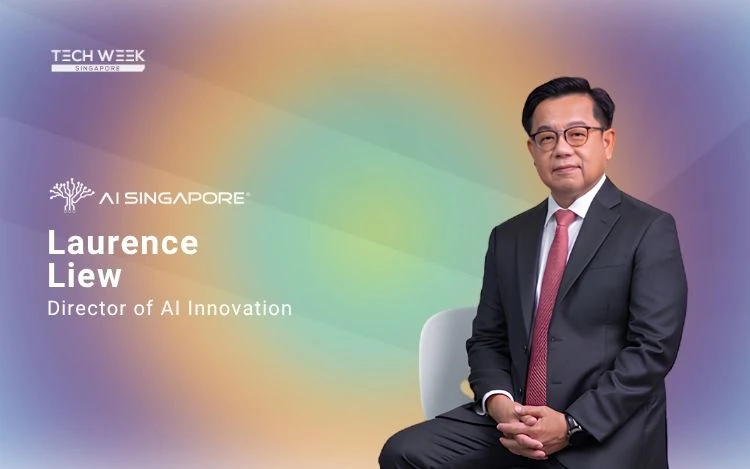
Laurence Liew is Director of AI Innovation at AI Singapore and the author of AI-First Nation: A Blueprint for Policy Makers and Organisation Leaders. Over 30 years in technology, he has helped more than 1,000 organisations adopt AI and reached over 300,000 professionals through AI literacy programmes. He is the architect of the 100 Experiments (100E) programme and the award-winning AI Apprenticeship Programme (AIAP), and creator of the AIRI Framework— an AI readiness measurement for organisations and individuals published as an open standard at airi.foundation and delivered through airihub.io platform. A sought-after speaker, he makes AI adoption practical