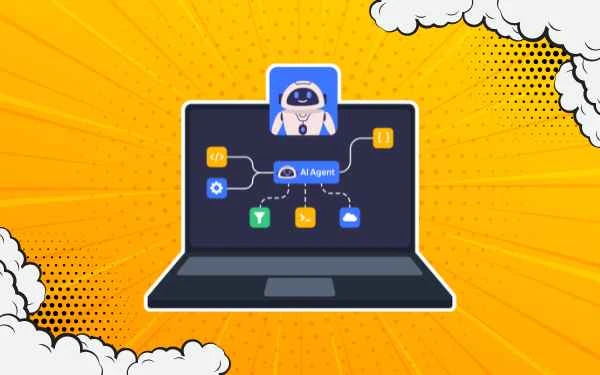






The rise of AI agents is forcing enterprises to rethink what their cloud infrastructure needs to manage. Instead of supporting people interacting with applications, cloud platforms increasingly need to coordinate autonomous software that can invoke models, access data, use tools and execute tasks. At HUAWEI CONNECT 2026, Huawei Cloud outlined an agentic hybrid cloud strategy designed around that shift, extending Huawei Cloud Stack across infrastructure, data, AI and its partner ecosystem.
Huawei Cloud President of Hybrid Cloud Antonony Gu said the growing use of AI agents is changing three layers of enterprise IT: who performs work, how computing resources are provisioned and what infrastructure teams need to manage.
The first change is the move from human-to-application interaction toward human-agent and agent-to-agent collaboration. Coding, customer service, workplace automation and other agents are beginning to perform multi-step tasks rather than simply generate responses.
That transition creates new infrastructure requirements. Agents repeatedly consume compute, data, models and tools, meaning enterprises need cloud environments capable of coordinating those resources as a unified service rather than managing isolated infrastructure components.
Huawei’s proposed architecture combines four capabilities: elastic cloud infrastructure, an AI-native capability layer connecting compute, data and tokens, an agent development and runtime platform, and integrated operations and security.
The timing reflects a broader enterprise shift. Gartner estimates that only 10% of organizations currently have agentic AI in production, while 80% are still working toward deployment. Gartner also projects that 40% of enterprise applications will include task-specific AI agents by the end of 2026, compared with less than 5% in 2025.
Huawei Cloud Stack is being adapted around this emerging workload model. On the infrastructure side, Huawei says its Agentic Infra supports its latest A5 SuperPoDs and technologies including NPU pooling and memory snapshots. The company claims these capabilities can raise compute utilization from 30% to 70%.
The data layer combines decoupled storage and compute with AI DataLake and DataArts, targeting multimodal data management and enterprise data governance. On the AI side, Huawei is combining foundation models with domain-specific models and tools such as OptVerse AI Solver for optimization and decision-making.
The company’s strategy also extends beyond infrastructure. Huawei Cloud says its AgentArts enterprise agent platform has already served more than 100 enterprises, while its Industry AI Foundry has accumulated more than 1,000 industry assets and more than 1,000 deployed projects.
For enterprise IT teams, the more important question is whether agentic infrastructure can reduce the complexity created by AI adoption. As agent counts grow, organizations will need consistent controls for identity, data access, model selection, observability, security and agent-to-agent interactions.
That makes hybrid cloud architecture an increasingly strategic layer of the AI stack. Huawei is positioning Cloud Stack as one answer, while hyperscalers and infrastructure providers including Microsoft, Google, Amazon, NVIDIA and IBM are pursuing their own combinations of AI platforms, cloud infrastructure and agent tooling.
The competition is therefore moving beyond simply providing access to foundation models. The emerging battleground is the infrastructure required to build, deploy, govern and operate autonomous AI systems at enterprise scale.
Market Landscape
Enterprise AI adoption is moving from isolated copilots toward agents capable of completing multi-step workflows. Gartner says only 22% of organizations had successfully scaled AI across multiple business units or adopted an AI-first approach as of its 2026 research, highlighting the gap between experimentation and enterprise-wide deployment.
That gap creates demand for platforms that combine AI compute, data infrastructure, model services, agent runtimes and governance. For enterprises evaluating an agentic hybrid cloud, interoperability, security, workload portability, model choice and operational visibility will be as important as raw model performance.
Huawei’s strategy reflects this broader infrastructure convergence, but its reported utilization, performance and adoption figures remain company claims and should be evaluated against independent benchmarks and enterprise workloads.
Top Insights
- Huawei Cloud is repositioning hybrid cloud infrastructure around AI agents that require coordinated access to compute, data, models and enterprise tools.
- Huawei Cloud Stack is evolving across infrastructure, data, AI and ecosystem layers to support enterprise agent development and production deployment.
- Agentic infrastructure introduces new operational requirements around observability, security, model governance and coordination between autonomous software systems.
- Huawei says its AgentArts platform serves more than 100 enterprises, while its Industry AI Foundry has surpassed 1,000 deployed projects.
- The emerging competition extends beyond foundation models toward infrastructure platforms capable of operating and governing AI agents at enterprise scale.
Power Tomorrow’s Intelligence — Build It with TechEdgeAI