








A product design team is brainstorming ideas. Ideas abound, but creativity belongs to that class of slippery concepts: it is ill-defined and hard to pin down. Usually, the leaders get a feeling for which concepts hold promise, but often, can’t seem to articulate a reason why. They can’t quantify which ideas will connect most with customers or inspire the next wave of innovation.
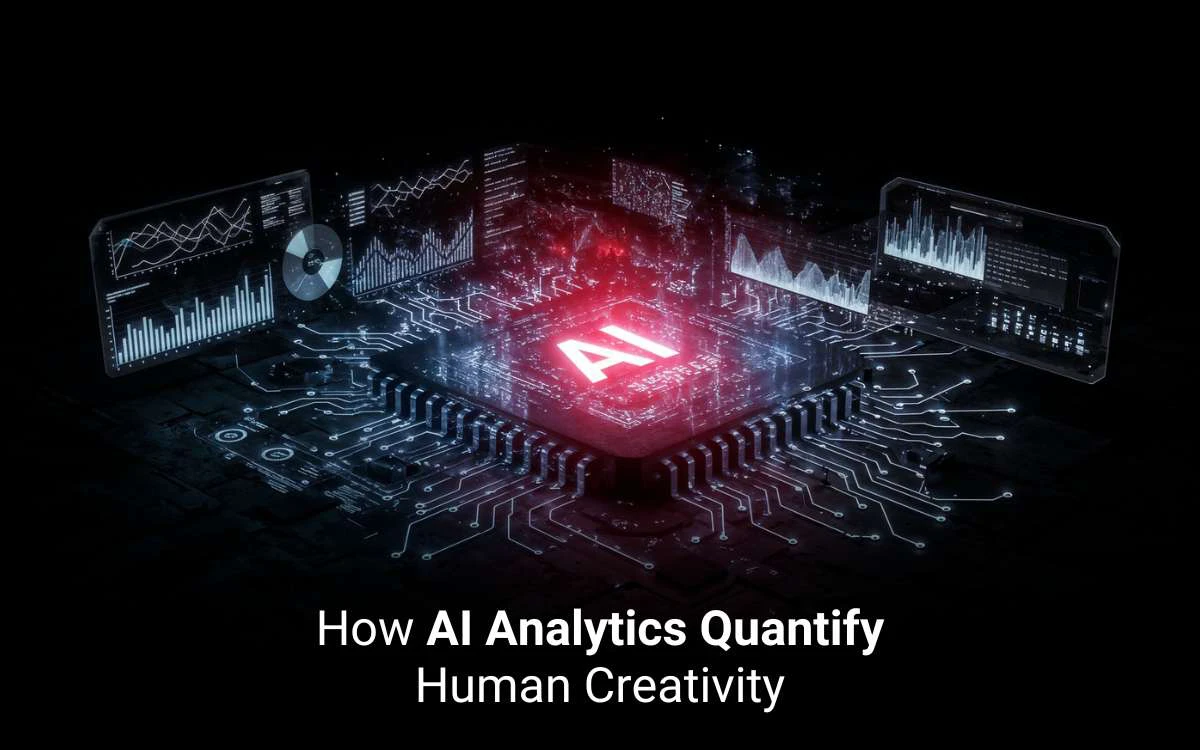
Human Creativity has for a long time been said to defy any kind of measure. The need for quantification does not reduce creativity to numbers but rather uncovers certain patterns in it. AI Analytics enables leaders to look at the creative output and measure it against historical performance and some of the behavioral outcomes.
The following is an article on how AI analytics can quantify human creativity.
What Makes Human Creativity Measurable?
The following are some of the elements that make human creativity measurable.
1. Creativity Yields Outputs
It can range from ideation to solve problems, design products, and campaigns to creating customer journeys. All creative efforts leave a digital footprint.
Example: Let us say the product team investigates a new workflow automation and creates prototypes and variations of interfaces. AI Analytics can analyze which concepts align with industry demand and historical adoption data.
2. Creativity Follows Patterns of Divergence
The most original ideas do, nevertheless, bear structural features which can be spotted. AI can benchmark the originality of an idea against data points to estimate how “new” or differentiated it is.
Example: When engineers propose design options for a new machine part, AI evaluates the individual models against the principles of engineering and products of competitors.
3. Impact Indicates Creativity Can Be Measured
AI Analytics predicts which creative directions will drive adoption, efficiency, or revenue impact and make creativity measurable.
Example: AI analyzes campaign ideas for a prediction of which story will drive more engagement by leveraging customer sentiment, intent signals, and benchmark performance from similar content.
4. Creativity Displays Cognitive Diversity
AI can map out ideation patterns, find blind spots, and quantify diversity of thought-all core ingredients for creativity.
Example: AI measures brainstorming sessions for those who put forth the best ideas.
5. Creativity Creates Measurable Emotional Resonance
AI can read tone, clarity, and emotional depth in text or visual deliverables to show what resonates best with target audiences.
For example, AI Analytics evaluates clarity and emotional relevance of long-form insights or thought-leadership drafts.
6. Iteration Lets Creativity Evolve, and That Evolution Can Be Followed
All refinement steps yield measurable signals of improvement and learning behavior.
Example: AI tracks the speed with which user feedback is integrated into prototypes by teams, highlighting which creative cycles are performing best.
Challenges of AI in Assessing Creativity
The following are the major challenges in implementing AI for assessment:
AI Challenge 1: Misinterpreting Context or Intent
Creative outputs also carry meaning, cultural nuances, and strategic intent missed by AI.
Example: AI scores a creative campaign idea intended to disrupt the industry as “too risky” because it was judged against historical benchmarks.
Solution: Employ hybrid models of evaluation whereby AI identifies trends, but human reviewers validate the relevance of that information. Embed domain-specific context layers in AI Analytics for better interpretation.
Challenge 2: AI Can Reinforce Existing Biases in Creativity Scoring
The AI will probably prefer “familiar” over “novel”, owing to biased historical data toward formats, styles, or decision-makers.
For example, AI that has been trained on previous UX designs could penalize prototypes since they don’t align with the pattern of their predecessors.
Solution: Diversification of training data, application of scoring metrics, and conducting bias audits.
Challenge 3: Over-Reliance May Stifle Experimentation
Teams begin designing ideas that achieve a high score on the metrics, not necessarily those that yield bold thinking.
For instance, it could be some high-risk idea that engineers may want to avoid, which AI labeled as low-probability success.
Solution: Make the framing of the AI supportive, not the decision-making process itself. Request proposals without the algorithm that are to be reviewed by humans.
Challenge 4: It is Difficult to Measure the Creativity of an Early-stage Idea
Representations of many raw concepts are often abstract and, as a result, hard to evaluate with AI.
But, for example, the initial solution may sound vague to AI; yet often they hold strategic insights that later become the bedrock of breakthrough solutions.
Solution: Have a multi-level review in which the AI reviews more structural aspects, like clarity, originality, and relevance, yet it saves human judgment on subjective factors like vision and long-term potentials.
Challenge 5: Data Privacy Concerns with Creative Insights
The most creative deliverables contain proprietary ideas, customer insights, or other forms of IP.
Example: AI pouring over design schematics, if not handled correctly, could lead to sensitive R&D information slipping out.
Solution: Utilize secure data pipelines, zero-trust access controls, and private-cloud AI models for evaluations.
Challenge 6: Creativity is Embedded with Emotion Which are Difficult to Quantify
Tones, empathy, humor, or telling strength could get lost with the AI algorithms.
Solution: Pair the AI scoring with human review so that emotional intelligence remains part of the core component of the assessment process.
AI-driven Measurement of Creativity in the Future
Some key future directions that shape the AI-driven measurement of creativity are summarized as follows.
1. AI Moving from Output Analysis to Process Intelligence
Instead of just scoring that final concept, AI analytics will track the entire creative process.
Example: might include AI mapping designers going from rough sketches to functional prototypes-a way for leaders to see how innovative behaviors work.
2. AI-Generated “Creativity Benchmarks” to Redefine Talent Development
Organizations benchmark patterns of creativity across teams, roles, and industries to set new measures of performance.
As an example,AI recognized that consistently top-performing teams in campaign creation demonstrate diversity, audience empathy, and rapid cycles.
3. Predictive Scoring will Complete the Investing Decisions
AI will predict what early-stage ideas will drive revenue, customer value, or competitive differentiation. It achieves this by evaluating R&D concepts against global trends, sustainability metrics, and market adoption curves to predict long-term viability.
4. AI Will Improve Cross-functional Alignment
Gone are the days when creativity exists in silos within marketing, product, or design. Instead, AI will spot how these ideas coming from different teams meet and complement one another.
Example: AI finds alignment between customer pain points surfaced by sales and product concepts proposed by engineers.
5. Emotional Intelligence Turns into Measurable Signals
Future AI models will decipher humor, metaphors, emotional arcs, symbolic meaning, and narrative resonance.
Example: AI analyzes long-form content for emotional tone and story strength and predicts which narratives will resonate most with audiences.
Conclusion
In a landscape in which innovation itself is marking the line of market leadership, the capability to measure Human Creativity becomes an imperative. The future belongs to those who treat creativity as a measurable engine of value creation. AI Analytics gives leaders the visibility they need to nurture, refine, and accelerate this engine.