








Globant is reshaping its operating model around AI-native enterprise services, appointing longtime executive Fernando Matzkin as Chief Operating Officer as the company moves to put its Glob.AI platform and AI Pods at the center of client delivery. The leadership change comes as the digital-services industry faces pressure to rethink how consulting, software engineering and enterprise transformation are delivered in an era of increasingly capable AI systems.
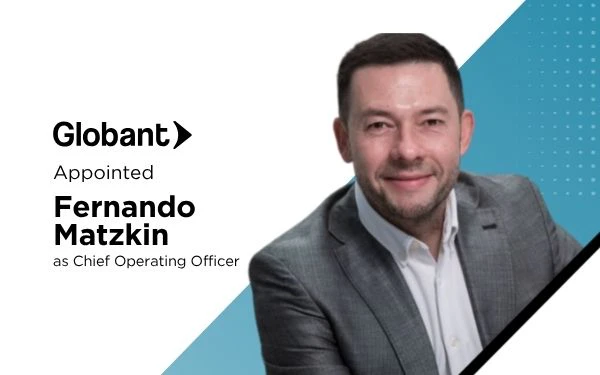
Globant has appointed Fernando Matzkin as Chief Operating Officer, giving the 17-year company veteran responsibility for translating its long-term strategy into day-to-day execution as the technology-services provider accelerates its AI transformation.
The appointment places Matzkin at the intersection of two changes affecting enterprise IT services: the growing adoption of generative and agentic AI, and the resulting pressure on technology-services companies to redesign their own delivery models.
Matzkin most recently served as Globant’s Chief Revenue Officer and previously held the role of Chief Business Officer for the United States and Europe. His new mandate includes evolving Globant’s operational model, improving client delivery and customer success, and driving commercial performance across key markets.
At the center of that mandate will be Globant’s Glob.AI offering and its AI Pods approach.
The company describes AI Pods as a way of organizing specialized AI capabilities around particular business needs. Rather than treating AI as an isolated consulting project, the model is intended to integrate AI into the way Globant builds and delivers technology services for clients.
That distinction is becoming increasingly important across the IT-services market.
For years, companies such as Accenture, IBM, Tata Consultancy Services and Cognizant built large businesses around teams of software engineers, consultants and managed-services professionals. Generative AI is now challenging the economics behind that model. AI coding assistants can automate portions of software development, while AI agents are beginning to handle multi-step workflows that previously required human intervention.
The result is not necessarily the disappearance of enterprise technology services. Instead, the competitive question is shifting toward how effectively providers can combine human expertise, AI systems and proprietary delivery infrastructure.
Globant’s leadership change reflects that transition.
As COO, Matzkin will be responsible for making the company’s AI strategy operational at scale rather than simply expanding its AI product portfolio. That includes connecting technology investments with client delivery, commercial performance and the company’s industry-focused structure.
For enterprise buyers, this is potentially more consequential than the executive appointment itself. If Globant’s AI-native strategy works as intended, clients could increasingly purchase technology transformation through AI-enabled delivery teams rather than conventional project structures dominated by human engineering hours.
The shift also puts Globant in a competitive field that includes much larger technology and consulting organizations. Microsoft and Amazon Web Services are embedding generative AI into enterprise cloud infrastructure, while Google Cloud is pursuing AI agents and model-based application development. Meanwhile, Salesforce and Adobe are integrating AI into business applications and marketing workflows.
Global IT-services firms occupy a different position. They can act as the implementation layer between those platforms and enterprises that lack the internal resources to redesign workflows, data architectures and applications around AI.
Globant’s challenge will be demonstrating that its AI-native services model produces measurable improvements in speed, quality and business outcomes rather than simply changing the terminology used to describe conventional consulting.
That question is particularly relevant as enterprises become more selective about AI spending. McKinsey’s 2025 global survey found that 88% of organizations report using AI in at least one business function, but most organizations are still working through the challenge of scaling AI beyond individual experiments and use cases.
The operational layer therefore matters. Deploying an AI model is relatively straightforward compared with integrating it into existing applications, data systems, security controls and employee workflows.
That is where Globant is positioning its AI Pods.
The company says Matzkin will use the model to accelerate its AI transformation while maintaining closer engagement with clients. The objective is to make AI a structural component of delivery rather than an additional capability attached to traditional services.
There is also a broader industry implication. As AI increasingly automates routine development and analytical work, professional-services companies may need fewer conventional delivery layers and more specialized teams capable of orchestrating AI systems.
That could change everything from pricing models to workforce composition.
For Globant, Matzkin’s promotion gives an experienced commercial executive responsibility for navigating that transition. His 17 years at the company provide continuity, but the COO role also represents a clear shift in emphasis: from expanding the business primarily through geographic and commercial growth toward redesigning how the business itself operates.
Globant CEO Martín Migoya described Matzkin as central to the company’s next phase and said the COO will help put Glob.AI and AI Pods at the center of client delivery.
The immediate test will be execution. AI-native services require more than new tools. They require repeatable processes, reliable governance, measurable productivity improvements and customers willing to change how technology work gets commissioned and delivered.
If Globant can establish that model at scale, the appointment could become part of a larger transformation in the global technology-services market—one where the differentiator is not simply access to AI, but the ability to operationalize it across enterprise engagements.
Market Landscape
Globant’s move comes as enterprise AI adoption moves from experimentation toward operational deployment. McKinsey’s latest research indicates that AI use is now widespread across organizations, but scaling remains a major challenge.
That creates an opening for IT-services companies. Enterprises may have access to foundation models through AWS, Microsoft Azure and Google Cloud, but turning those models into secure, production-grade business systems often requires application engineering, data integration, workflow redesign and change management.
Globant is betting that its AI Pods and Glob.AI can become part of that implementation layer.
The competitive pressure is significant. Accenture has invested heavily in generative AI services, while IBM combines consulting with its watsonx AI platform. Indian IT-services providers such as TCS and Infosys are also building AI-led transformation practices.
The differentiator will increasingly be measurable outcomes: faster software development, lower operating costs, improved customer experiences and the ability to deploy AI systems reliably across complex enterprises.
Top Insights
- Globant appointed Fernando Matzkin as COO, giving a longtime commercial executive responsibility for operationalizing its AI-native services strategy and improving enterprise client delivery.
- Glob.AI and AI Pods will sit at the center of Matzkin’s mandate, signaling Globant’s shift from standalone AI offerings toward AI-integrated technology-services delivery.
- Enterprise AI adoption is accelerating, but organizations still face challenges scaling AI from experiments into production workflows, creating opportunities for technology-services providers.
- Globant competes with Accenture, IBM, TCS and Infosys, while cloud platforms from Microsoft, AWS and Google increasingly provide the underlying AI infrastructure.
- The COO appointment highlights a wider services-market shift, as AI automation forces consulting firms to rethink delivery models, workforce structures and the economics of software development.
Power Tomorrow’s Intelligence — Build It with TechEdgeAI