








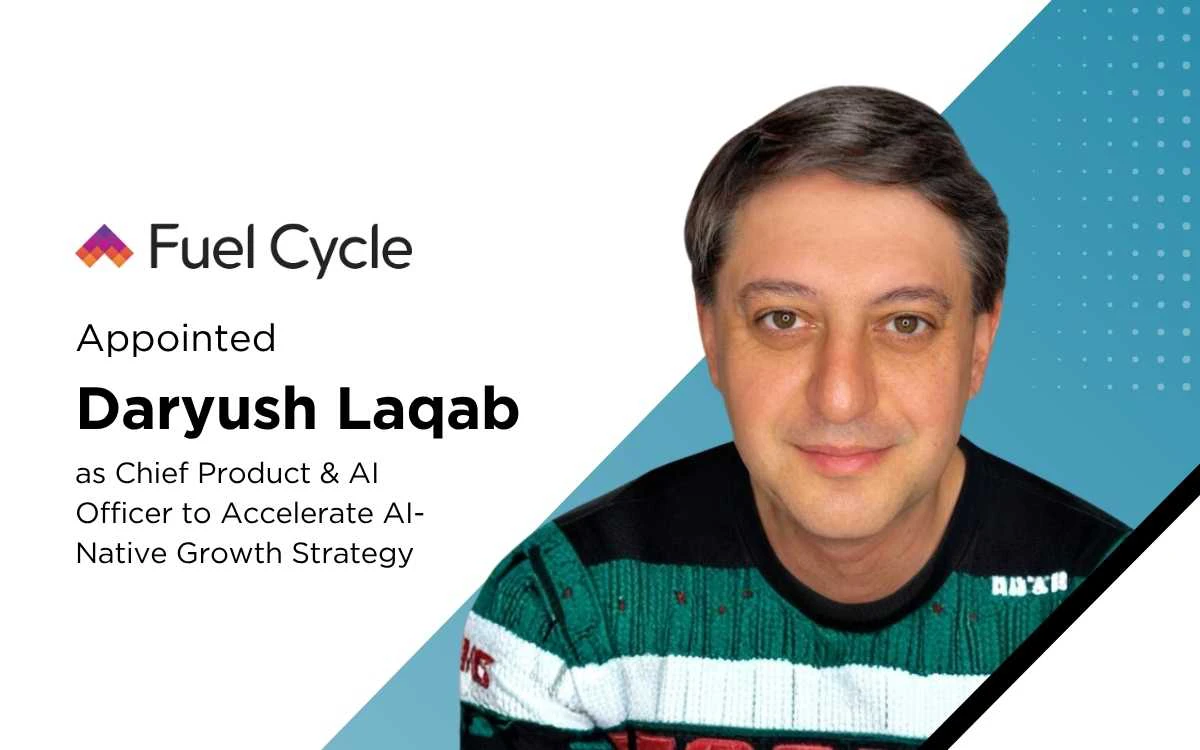
Fuel Cycle, the AI‑powered consumer intelligence platform trusted by Fortune 500 brands, announced today that Daryush Laqab has been appointed Chief Product & AI Officer, a move that signals the company’s push to build the first purpose‑built market‑research AI solution.
Leadership change fuels AI‑first strategy
Effective June 1, 2026, Laqab will steer Fuel Cycle’s product roadmap as the firm pivots from a traditional research platform to a full‑stack Market Research AI suite. With more than two decades of experience at Google, NVIDIA, and JPMorgan Chase, he brings a rare blend of large‑scale AI infrastructure expertise and product leadership. His résumé includes launching Google Contact Center AI, steering speech‑to‑text services, and overseeing NVIDIA’s AI‑hardware integration—credentials that align with Fuel Cycle’s ambition to embed AI‑first strategy, intelligence, and speed into every stage of consumer insight generation.
What the new platform promises
Fuel Cycle’s emerging Market Research AI aims to compress the classic “question‑to‑decision” cycle. By unifying owned audiences, first‑party data, proven research methodologies, and advanced analytics, the platform intends to deliver always‑on, AI‑driven insights. In practice, this could mean a brand’s marketing team asking a single query—such as “How will Gen Z respond to a new packaging concept?”—and receiving statistically robust, actionable recommendations within hours rather than weeks.
Why the appointment matters for the industry
The AI‑driven research market is heating up. IDC forecasts that worldwide spending on AI‑enabled analytics will exceed $145 billion by 2027, driven largely by enterprises seeking faster, data‑centric decision making. Fuel Cycle’s decision to place an AI veteran at the helm of product underscores a broader shift: AI is no longer a peripheral add‑on but the core engine of consumer intelligence platforms. Competitors such as Qualtrics, SurveyMonkey (Momentive), and Adobe Experience Platform are all racing to embed generative AI into survey design, sentiment analysis, and predictive modeling. Laqab’s background in both AI infrastructure and enterprise product scaling could give Fuel Cycle a decisive edge in delivering a solution that is simultaneously robust, secure, and easy for non‑technical marketing teams to adopt.
Impact on enterprise marketing teams
For large‑scale marketers, the promise of an AI‑first research engine translates into three tangible benefits. First, it reduces reliance on external agencies for ad‑hoc studies, cutting costs and shortening go‑to‑market timelines. Second, the platform’s ability to ingest first‑party data means insights are grounded in a brand’s own customer interactions, improving relevance and compliance with privacy regulations such as GDPR and CCPA. Third, the automation of data cleaning, weighting, and statistical testing frees analysts to focus on strategic interpretation rather than manual preprocessing.
Comparative landscape
While Qualtrics’ XM Platform emphasizes experience management across touchpoints, it still leans heavily on traditional survey workflows. Adobe’s AI‑powered Sensei integrates generative text for content creation but lacks a dedicated, end‑to‑end market‑research engine. Fuel Cycle’s differentiator lies in its “purpose‑built” approach: a vertically integrated stack that couples AI‑generated questionnaire design with real‑time respondent recruitment and automated insight extraction. If Laqab can deliver on this vision, the company could set a new benchmark for speed‑to‑insight in the B2B research space.
Strategic implications
The appointment also signals Fuel Cycle’s intent to deepen its AI‑first product development as demand for scalable, automated consumer intelligence climbs across the Fortune 500. By aligning product, engineering, and AI strategy under a single executive, the firm is better positioned to iterate rapidly, integrate emerging LLM capabilities, and respond to evolving data‑privacy standards.
Market Landscape
The convergence of generative AI, large language models, and cloud‑native infrastructure is reshaping how enterprises gather and act on consumer data. Gartner predicts that by 2028, 75 % of large enterprises will rely on AI‑driven insights for at least half of their strategic decisions, up from 30 % in 2023. Cloud providers—Google Cloud, Amazon Web Services, and Microsoft Azure—are rolling out specialized AI services that lower the barrier for companies to embed custom models into SaaS offerings. In this context, Fuel Cycle’s focus on a dedicated Market Research AI platform places it at the intersection of AI innovation and enterprise adoption, a sweet spot that could attract both direct customers and strategic partners seeking to embed research capabilities into broader CRM or CX suites such as Salesforce or Adobe Experience Cloud.
Top Insights
- Leadership with deep AI pedigree – Daryush Laqab’s track record at Google, NVIDIA, and JPMorgan Chase equips Fuel Cycle to scale AI infrastructure while maintaining product usability.
- Purpose‑built market‑research AI – Fuel Cycle aims to compress the insight cycle from weeks to hours, offering always‑on, first‑party‑data‑driven analytics for enterprise marketers.
- Competitive differentiation – Unlike broad experience‑management platforms, Fuel Cycle’s vertical focus on research could set a new speed‑to‑insight standard in the B2B analytics market.
- Enterprise impact – Faster, AI‑automated insights promise cost reductions, improved data privacy compliance, and more strategic analyst time for marketing teams.
- Industry momentum – IDC and Gartner forecasts indicate rapid growth in AI‑enabled analytics spending, positioning Fuel Cycle to capture a sizable share of the emerging market.
Power Tomorrow’s Intelligence — Build It with TechEdgeAI