








1. Enterprise AI projects involve multiple teams, legacy systems, and competing priorities. How can organisations overcome these barriers without allowing implementation complexity to undermine the business case?
Start with a business problem that matters, and understand the workflow around it before choosing where AI fits. You can balance the value with complexity and risk of your first AI projects, but if you start by rolling out tools or “enabling platforms” across the organisation, you can spend a lot of money before anyone agrees on what success looks like.
Asana’s Australian AI Execution Index illustrates the challenge. Half of enterprise respondents report organisation-wide or embedded AI adoption, compared with 42% in smaller and mid-sized organisations. Yet enterprises score lower on execution. The largest gaps are in workflow integration and coordination across functions. Having more resources and more AI does not automatically make the work connect or have you see the business impact. It is therefore important that you focus on “workflows” not “tasks” to ensure you’re actually moving the needle on meaningful company or departmental metrics.
I would choose one important workflow, then bring the relevant teams together, and map its dependencies, system requirements, and decision points. Give someone responsibility for the overall outcome, establish a baseline, and test whether the improvement holds. That makes complexity visible early and gives you evidence for the next investment.
2. To what extent is the gap between AI ambition and execution a technology problem, and how much of it comes down to organisational process, ownership, and decision-making?
Technology matters. If systems cannot exchange information or the data is unreliable, execution will suffer. But I think organisations often underestimate the work needed to change how people make decisions and coordinate around a shared goal. A capable model cannot resolve unclear priorities or decide who should own a business outcome.
Our research found a big gap between how executives and knowledge workers rate AI execution. These are independently sampled groups, but the contrast is useful: leaders may see investment, strategy, and governance, while employees experience whether the tools actually fit their work.
The practical response is to examine both perspectives. Pick a workflow and ask the people involved where work stalls, who makes decisions, where handover fails, what the risks are, and what happens when something goes wrong. You may find a technical limitation, an ownership gap, or an approval process that nobody has revisited. The solution depends on diagnosing the actual obstacle. Buying another tool before doing that can simply add another layer.
3. AI agents are expected to move beyond generating responses and execute tasks across business systems. What needs to change in an organisation’s technology architecture and operating model to support this shift and what is the shift?
An agent needs more than access to a powerful model. It needs to understand the work: what outcome we are trying to achieve, what information is relevant, which tasks depend on others, and what it is authorised to do, basically it needs to know the same as a human. Generating a useful response and moving a complex coordinated cross-functional workflow forward have different consequences.
Architecturally, that means reliable connections between systems, appropriate permissions, current information, a “work graph” architecture (information on “who” is doing “what” by “when”, “how”, and “why”) and a way to see what the agent has done. You also need controls for exceptions and human approval. If an agent changes something, people should be able to understand the action and intervene where necessary.
The operating model needs equally clear boundaries. Who owns the workflow? Which decisions can be automated, which need assistance, and which require human judgement? Those boundaries will evolve as capabilities improve. Someone needs responsibility for reviewing them, checking results, and adjusting the workflow. Giving agents more autonomy should be a deliberate decision based on performance and risk.
4. How can organisations introduce AI agents into existing workflows without forcing employees to adopt entirely new tools or change established ways of working?
Start where people already work, and focus on a problem they recognise. That might be gathering information for an approval, routing a request, or identifying a dependency that would otherwise be missed. People should be able to understand how the agent helps them complete the work.
Where practical, connect that support to existing systems and keep the experience familiar. But I would be careful about promising that nothing needs to change. Sometimes the established process is the problem. That said, there’s some interesting psychological research around habit forming that I was exposed to through a podcast with BJ Fogg, where the likelihood and willingness to adopt a new habit are proportional to the perceived value of doing things “the new way”. People need to see and feel the benefit. Then the other great thing is that agents can operate somewhat autonomously, proactively, ambiently and somewhat human-like inside workflows, which makes the adoption even easier.
Involve employees in designing and testing the workflow. They know where the exceptions are and where an apparently simple task needs judgement. Give them practical guidance on what the agent does, when to review its work, and how to escalate a problem. Adoption becomes much easier when people can see the benefit and have helped shape the change.
5. Many AI projects report time savings or increased output, but these metrics do not always translate into financial returns. How can organisations determine whether AI is improving business performance rather than increasing activity?
Making an individual faster does not automatically make the organisation more effective. You can generate a presentation in minutes, but somebody still has to read it, decide whether it is useful, and act on it. If AI creates more material without improving those decisions, you may simply move the workload to someone else. That is why we have to focus on end-to-end workflows, to ensure we see the business impact (i.e. opening more stores and increasing revenue, getting fashion drops to market faster bringing forward revenue, dealing with compliance matters faster to save money – whatever the workflows are and how they impact you saving or making money).
Asana’s research found that 91% of respondents reported at least one measurable improvement from AI in the previous 12 months. That is encouraging. But the average was only 3.1 improvements across ten outcome areas, which suggests the benefits are not yet broad.
So start with the business result and work backwards. If the objective is faster product delivery, measure the full delivery cycle, including approvals, quality, and rework. Then assess the costs of achieving that improvement, including integration, oversight, and ongoing usage. Saving or making money is the objective. Time saved is useful evidence too, but you need to know what happens to that capacity and how to channel it into improved business outcomes.
6. Which measures should executives prioritise when evaluating AI initiatives: cost reduction, revenue growth, cycle time, decision quality, customer outcomes, or employee productivity? How should these measures vary by use case?
The priority should follow the business problem. A customer service initiative should be judged on whether customers get their issue resolved, alongside cost and response time. A product development initiative might prioritise time to market and quality. For an internal approval process, cycle time and rework could be more useful starting points.
I would pair the intended benefit with measures that reveal trade-offs. Faster service means little if customers have to contact you again. Lower processing costs can be misleading if another team spends more time correcting errors. Employee productivity also needs context: are people using the capacity to do more valuable work, or are they reviewing a growing volume of AI output?
Agree on those measures before deployment, establish the baseline, and name the person accountable for the result. Revenue and cost matter, but the measures should also explain how the workflow contributes to them. Otherwise, you risk claiming a financial benefit without understanding what actually changed.
7. How should responsibility for AI execution be divided between business leaders, technology teams, and operational owners to ensure that deployments remain aligned with business priorities?
Organisations should appoint a named owner for the business outcome, with clear responsibilities around them. Shared involvement is essential, but if everyone is broadly responsible for ‘AI transformation’, decisions can fall between teams.
Business leaders should set the priority, define the intended value, and resolve competing demands. Technology teams should establish the architecture, integration, security, and data conditions that make execution reliable. Operational owners should shape the workflow, manage exceptions, and check whether the change improves day-to-day performance. Risk and people teams also need to be involved where controls, roles, or training change.
Keep those responsibilities visible in the same execution plan, with agreed milestones, dependencies, and measures. In Asana’s research, 14% of knowledge workers said there was no clear owner for AI value or they were unsure. Accountability needs to be understood by the people doing the work, including who can make a decision when the workflow is not delivering. It is important to empower people but we believe it is also important to hold people accountable for the results of AI.
8. If a business leader wants to move from AI experimentation to measurable execution over the next 12 months, which three priorities should they address first?
First, understand where ambition and experience diverge. Ask leaders and employees the same questions about workflow fit, training, visibility, ownership, and value. Then investigate the biggest difference in a real workflow (look at your key value streams). The purpose is to find the friction or opportunity, and give someone responsibility for addressing it.
Second, choose one high-value business problem and make the delivery plan explicit. Define the outcome, baseline, accountable owner, participating teams, dependencies, and guardrails. Asana’s research found that 61% of AI Executors, those respondents whose organisations had combined advanced AI adoption with measurable improvements, had a documented roadmap with priorities, owners, and measures, compared with 36% of AI Adopters.
Third, prove the improvement across an end-to-end workflow before expanding it. Prepare the people involved, define where human judgement is needed, and measure quality and rework alongside speed and the business outcome. Ensure your implementation approach can scale, that you’re building a “platform” that can be leveraged for future workflows. Review the results with the team and refine the process. Within months, the goal should be to build a repeatable way of delivering value that the next team can use.
Bio:
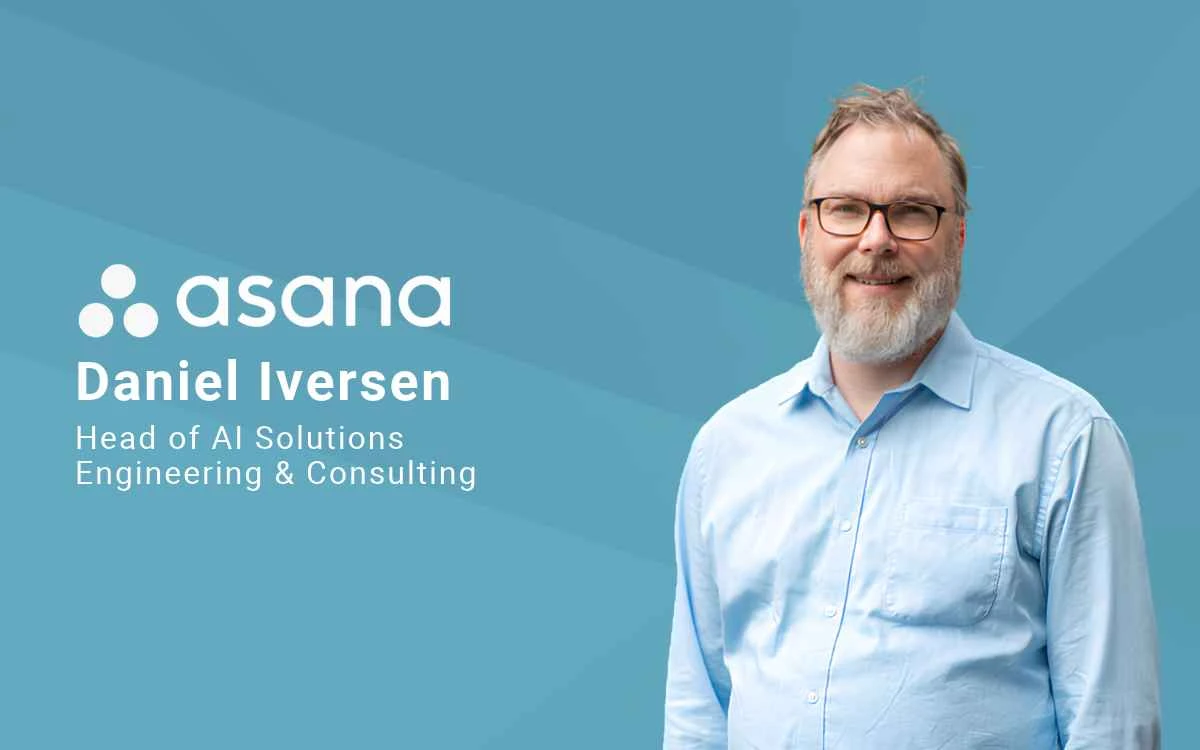
Daniel is a technical leader, building teams and regions, consulting around AI, modern/future of work, innovation, corporate culture, and productivity, He enjoys helping teams and individuals find purpose, reduce stress, and work with impact. For 20+ years he has helped build and lead teams and businesses of a variety of sizes and shapes in tech across Europe, Asia Pacific, and Japan.
He is a passionate evangelist and has held a variety of leadership positions across consulting, implementation/professional services, presales, Customer Success, General Management and more, and loves working with innovators and leaders to help make an impact on how work happens.
Daniel is working at Asana as Head of Solutions Engineering and AI Consulting for APAC, where they’ve re-imagined how work gets done and built an Operating System for Humans and AI Agents to work together to achieve organisational goals.
Company information
Asana is the operating system for human-agent teams. Built on 18 years of foundational architecture, the Enterprise Work Graph ®, multiplayer collaboration, shared memory, and governance, it is exactly what the agentic era requires: a place where humans and agents run critical workflows together, on the same plan, toward the same goals — unlocking enterprise productivity.