








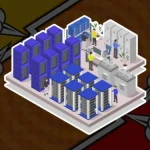

The next phase of AI infrastructure is shifting the focus from individual GPUs to entire AI factories—data centers engineered to turn electricity and accelerated computing into continuous AI output. Delta Electronics is developing an integrated power and cooling infrastructure stack for AI factories based on NVIDIA’s DSX platform, targeting a central challenge for operators: getting more usable compute from every available megawatt.
Delta’s approach connects infrastructure that has traditionally been engineered in separate layers, from onsite energy storage and medium-voltage power systems to rack-level distribution, liquid cooling and chip-level power delivery.
The company is integrating energy storage systems, solid-state transformers and medium-voltage infrastructure at the facility level, while its IT infrastructure combines 800 VDC power delivery with liquid cooling. The objective is to better match power delivery and heat removal with the rapid load changes generated by high-density AI accelerators.
That matters because AI data centers are becoming substantially more power-intensive. Gartner forecasts that global data center electricity consumption will reach 565 TWh in 2026, with AI-optimized servers accounting for 31% of data center power consumption. The research firm expects data center electricity consumption to continue rising as AI workloads expand. (gartner.com)
Delta says its 800 VDC architecture can achieve up to 98% power conversion efficiency while responding rapidly to GPU load transients. Its high-density In-Row systems can provide up to 800 kW per power rack, while board-level DC-DC technology can deliver peak efficiency of 98.5%, according to the company.
The thermal side of the architecture is equally important. Delta’s portfolio includes liquid-to-liquid cooling distribution units rated at 2.4 MW and 3 MW, along with in-rack cooling and component-level thermal technologies.
The strategy aligns with NVIDIA’s broader push toward system-level AI infrastructure. NVIDIA’s DSX platform brings together accelerated computing, software, reference designs and facility infrastructure to help data center operators design and deploy AI factories as integrated systems rather than collections of individual components.
The physical infrastructure layer is becoming increasingly important as rack densities rise. NVIDIA has been advancing liquid-cooled architectures for its latest AI systems, while hyperscalers and data center operators are also investing in direct-to-chip cooling and higher-voltage power architectures.
Delta is also targeting deployment speed. Its Prefabricated AI Modular Data Center Solution integrates 800 VDC In-Row Power and up to 3 MW of liquid-cooling capacity into factory-assembled infrastructure blocks. The approach moves more integration and testing away from the construction site, potentially reducing commissioning complexity and supporting incremental capacity expansion.
For enterprise and hyperscale operators, the significance extends beyond efficiency percentages. AI factory economics increasingly depend on how quickly power can be converted into productive GPU capacity, how effectively heat can be removed and how much infrastructure capacity can be deployed without creating stranded space or electrical overhead.
That puts companies such as Delta, NVIDIA, Schneider Electric, Vertiv, Eaton and Siemens into an increasingly interconnected AI infrastructure market. Competition is no longer limited to compute hardware. Power architecture, cooling, modular deployment and facility-level orchestration are becoming part of the technology stack required to scale AI.
Market Landscape
AI infrastructure is increasingly constrained by electricity availability, grid connections and thermal density rather than compute hardware alone. The International Energy Agency projects global data center electricity demand to nearly double from 2025 to 2030, reaching around 950 TWh, with AI a major driver of the increase. (iea.org)
This is driving investment in higher-efficiency power conversion, direct liquid cooling, high-voltage distribution, battery-backed power systems and prefabricated data center infrastructure.
For AI factory operators, the emerging architecture is increasingly holistic: power generation and storage, electrical distribution, GPUs, networking, cooling and software must operate as one system. The value of technologies such as 800 VDC will ultimately depend on system efficiency, reliability, safety, interoperability and deployment economics in production environments.
Top Insights
- Delta is developing integrated power and cooling infrastructure for NVIDIA DSX-based AI factories as operators seek greater compute output from constrained electricity supplies.
- The company’s 800 VDC architecture targets high-density AI racks by reducing conversion stages and responding to rapid GPU power-load changes.
- Delta combines facility-level energy systems with rack and chip-level power technologies, creating a continuous infrastructure path from electricity supply to AI compute.
- Liquid cooling is becoming increasingly important as AI accelerator densities rise, with Delta offering cooling distribution systems rated up to 3 MW.
- Prefabricated infrastructure could shorten AI factory deployment by moving integration, testing and validation from construction sites into controlled manufacturing environments.
Power Tomorrow’s Intelligence — Build It with TechEdgeAI