





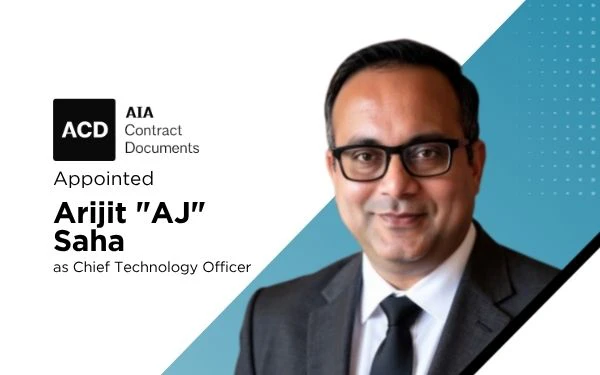
Construction contracts are becoming another frontline for enterprise AI as architecture, engineering and construction firms look for ways to reduce negotiation friction and manage project risk. AIA Contract Documents (ACD) has launched an in-app AI Assistant alongside a redesigned contract-editing experience, while appointing technology executive Arijit “AJ” Saha as chief technology officer. The move puts AI directly inside one of the industry’s most established contract-document workflows.
AIA Contract Documents Brings AI Into Construction Contract Workflows
For construction companies, delays do not always begin on the jobsite. A disagreement over contract language, an unclear responsibility or a missed risk allocation can create problems long before construction starts.
AIA Contract Documents is now bringing artificial intelligence into that part of the project lifecycle.
The organization has launched an AI Assistant designed to provide on-demand guidance within its contract workflow, alongside an upgraded editing experience intended to make it easier for project teams to move from a standard document to a completed agreement.
ACD is also strengthening its technology leadership, appointing Arijit “AJ” Saha as chief technology officer. Saha will oversee the company’s technology and AI strategy as ACD expands its software capabilities for architecture, engineering and construction (AEC) organizations.
The announcement represents a broader transition for construction technology. AI adoption in the sector has largely focused on areas such as estimating, scheduling, design and document analysis. Contracting is another potentially valuable application because agreements sit at the intersection of cost, risk, responsibilities and project execution.
A Contract Assistant Rather Than Another Standalone Chatbot
ACD’s AI Assistant is designed to operate within the company’s contract environment rather than requiring users to move contract-related questions into a separate general-purpose AI service.
That distinction is important for professional workflows.
A general AI chatbot can explain contract concepts, but construction teams often need assistance in the context of a specific document, project and negotiation. Embedding AI inside the contracting workflow can reduce the need to copy information between systems and potentially make guidance more useful at the point where a decision is being made.
ACD says users can request guidance at different stages of the contracting process.
The company is initially positioning the assistant as an aid rather than an autonomous decision-maker. That is appropriate for contracts, where legal interpretation, commercial terms and project-specific risk can have significant financial consequences.
The longer-term roadmap is more ambitious. ACD says it is developing additional AI capabilities that could help customers assess project risk and complete contract-related tasks.
A Large Existing Contract Ecosystem Gives ACD an Advantage
ACD enters the AI market with something many newer construction-tech startups lack: a large library of standardized industry contracts and an established user base.
The organization says it offers more than 300 standardized contract documents and is used by more than 45,000 companies, with more than 1.2 million contracts written each year.
ACD also says its documents support approximately $100 billion in contract value annually.
Those figures are company-reported, but they illustrate why the company’s AI strategy could have a meaningful distribution advantage.
AI tools are only as useful as their integration into workflows. A platform already used by architects, engineers, contractors and other construction professionals can introduce AI assistance directly into an established process rather than asking companies to adopt an entirely new system.
That does not automatically make the technology better. But it can lower the adoption barrier.
Construction Technology Is Moving Toward Connected Workflows
The contracting announcement fits into a wider evolution of construction software.
Traditional AEC technology has often been divided among specialized categories: design software, project management, estimating, document management, scheduling, procurement and contract administration.
Companies such as Autodesk, Procore, Oracle and Trimble have increasingly connected those workflows through cloud platforms and data integrations.
AI adds another layer.
Instead of simply storing project information, software can potentially interpret documents, identify inconsistencies, summarize changes, surface risks and assist users with repetitive tasks.
Contracts are particularly suitable for this type of technology because they contain structured and unstructured information that can be compared against project requirements and other documentation.
But construction contracts also create a high bar for reliability.
An AI system that confidently provides incorrect guidance could introduce legal or financial risk. Enterprise adoption will therefore depend on traceability, permissions, data security and clear distinctions between AI-generated guidance and professional legal judgment.
New CTO Brings AI and Cloud Experience
Saha’s appointment suggests ACD intends to make AI a central part of its product strategy rather than treating the new assistant as a standalone feature.
He brings more than two decades of experience across engineering, data, AI and cloud technology teams. His background includes Infosys, Goldman Sachs, Noodle AI (now Daybreak) and Redica Systems, where he most recently served as CTO.
His role will include advancing tools intended to support workflows across the construction lifecycle.
That could become important as ACD looks beyond document creation.
The contract is only one piece of the construction information chain. Project changes, payment terms, insurance requirements, responsibilities and dispute provisions can connect directly to project execution.
An AI system capable of understanding those relationships could eventually move from answering questions about a contract toward identifying potential project risks before they become disputes.
That is a considerably harder technical problem.
AEC Firms Need AI That Fits Existing Governance
For enterprise construction organizations, the key question will not simply be whether ACD’s AI Assistant can answer contract questions.
It will be whether the technology can operate within existing governance structures.
AEC firms often involve multiple stakeholders in contracting: owners, architects, engineers, contractors, subcontractors, project managers and legal teams. Each may have different responsibilities and access requirements.
An enterprise-grade AI workflow therefore needs to account for document permissions, version control and auditability.
It also needs to preserve the authority of the humans responsible for commercial and legal decisions.
ACD’s decision to introduce on-demand assistance rather than immediately positioning the system as an autonomous contract agent reflects that reality.
The likely near-term opportunity is AI-assisted contracting, where software handles information retrieval, explanation and repetitive analysis while people remain responsible for approval.
The Competitive Question Is Workflow, Not Just AI
ACD is entering a market where AI capabilities are increasingly becoming standard features in enterprise software.
Microsoft is embedding Copilot capabilities across business applications, while specialized platforms are adding generative AI to legal, procurement and project-management workflows. In construction, established technology providers including Autodesk and Procore have also been investing in AI-driven capabilities.
ACD’s differentiator is its specialized contract domain.
Its competitive challenge will be turning that domain expertise into an AI system that is more useful for construction professionals than a generic large language model.
The company’s standardized documents provide an important foundation. Its user base provides distribution. The next step is proving that AI can reliably help firms reduce administrative effort and identify risks without creating new ones.
What It Means for Enterprise Construction Teams
For AEC firms, the announcement points toward a gradual change in how contracts may be managed.
Instead of treating contract documents as static files that professionals manually review and edit, future systems could make them interactive sources of project intelligence.
Teams could ask questions about obligations, identify differences between versions, surface potentially problematic provisions and eventually connect contract requirements with project-management data.
That future is not fully here yet.
But ACD’s launch illustrates where construction software is heading: AI is moving from generic productivity tools into specialized workflows where industry context matters.
For a sector in which contractual ambiguity can translate into costly disputes and delays, that may be one of the more consequential applications of enterprise AI.
Market Landscape
The construction technology market is increasingly converging around AI-enabled workflows.
- Contract management: AI can assist with document analysis, clause discovery, editing and risk identification.
- Project management: Platforms increasingly use AI for scheduling, forecasting, documentation and project intelligence.
- Design and engineering: Generative design and AI-assisted engineering are becoming more integrated into AEC software.
- Risk management: AI can analyze large volumes of project and contractual information to identify potential issues.
- Enterprise collaboration: Cloud platforms are connecting contracts with project, financial and operational data.
ACD’s advantage is its specialized contract library and established AEC customer base. Its challenge is demonstrating that AI assistance can deliver measurable workflow improvements while maintaining the accuracy and governance expected for contractual documents.
Top Insights
- AIA Contract Documents launched an in-app AI Assistant designed to provide contract guidance while users work through construction agreements.
- The upgraded editor and AI Assistant aim to reduce friction between standardized contract templates, negotiation and completed agreements for AEC teams.
- ACD appointed AI and cloud technology executive AJ Saha as CTO to lead its technology strategy and future AI product development.
- More than 45,000 companies use ACD documents, giving the organization an established enterprise distribution channel for construction-focused AI tools.
- Future capabilities are expected to address project risk and contract-related tasks, potentially expanding AI from document assistance toward construction risk management.
Power Tomorrow’s Intelligence — Build It with TechEdgeAI