





Do you think the next competitive advantage will come from having better AI tools, or from redesigning the workflows around those tools? Why?
The advantage is going to come from what you do with the tools, not just having access to better ones.
Most marketers already have a lot of technology and customer data. In fact, 78% say they collect enough information to personalize a response to every inbound lead, but 65% still struggle to act on it. That doesn’t scream more tools to me, it tells me that we need to get better at connecting what we already know about the customer to what happens next.
That’s where AI gets interesting. Today, 68% of marketers move leads through four or more platforms before the first response, but only 28% use AI to trigger routing and follow-up workflows. The competitive advantage will come from using AI to close those gaps, so customer context doesn’t get lost and teams can act on what customers are telling them while it still matters.
When customer intent is captured but the next action is delayed, what does that tell you about the maturity of the marketing operation?
I’d say the operation is stunted. There are a lot of different parts of the customer journey, and you can be doing individual pieces really well while the overall experience still isn’t working. For example, 80% of marketers say they already collect enough information to personalize their outreach, yet seven in ten organizations still leave at least a quarter of their leads waiting more than 24 hours for a response.
So I’d argue those teams are on the right track, they have the customer information and they’re investing in the technology. The next step is figuring out exactly where things are breaking down and why. Once you understand where the customer information is getting stuck, you can solve the actual problem instead of assuming another tool or more data is the answer.
Where do you see the biggest disconnect between the insight a marketing team has and the action it ultimately takes?
The biggest disconnect is often in how quickly customer insight actually makes its way into action. Marketers have more signals coming from customers than ever, but that information can still get stuck between platforms, teams or manual processes before it changes what the customer experiences.
In our research, marketers told us they have enough information to personalize their outreach, but they’re still taking too long to act on it. If a customer tells you what they want, but that insight doesn’t shape your next campaign, inform how you iterate an existing one or change the messaging and creative they see, the insight itself isn’t doing much for you.
Marketers need to look closely at the workflow between capturing customer intent and leveraging it, asking where the information is still moving manually or where context gets lost that’s stalling insight to action. The goal should be to shorten the distance between what a customer tells you and what your team does with it.
As marketing stacks become more complex, is consolidation becoming as important as adding new capabilities?
Tool sprawl is a huge issue we’re seeing within the marketing space and teams should worry less about how many tools they have and more about what those tools are actually helping them accomplish. If you’re paying for ten different platforms but the customer experience is still slow or your team is spending hours on manual work, adding an eleventh probably isn’t the answer.
There’s also so much capability already sitting inside the platforms marketers use every day, especially as companies add AI features. Before buying something new, I’d make sure you really understand what you’ve already paid for and whether you’re taking advantage of it.
Do you think marketers have become too focused on measuring customer behavior without spending enough time understanding the motivations behind it?
Behavior has historically been much easier for marketers to measure than intent. We can see when someone clicked, what page they visited or when they dropped off, but the context behind those actions, like what they were looking for or what changed their mind, has been nearly impossible to get.
That creates a gap between knowing what customers are doing and understanding why they’re doing it. Marketers are often left interpreting behavioral signals and making assumptions about the intent behind them, so decisions become bets rather than strategies rooted in customer understanding.
What’s changing now is our ability to actually get that context at scale. For the first time, marketers have an opportunity to get closer to the “why” without having to choose between the scale of behavioral data and the depth of traditional customer research. That gives us a much richer understanding of what customers actually want instead of trying to infer it from their clicks alone.
Behavioral data can tell marketers what customers did, but it does not explain why they did it. How important is that “why” to your marketing strategy?
I’d argue it’s the most important part. My north star as a marketer has always been to stay as close to the customer as possible because that’s where the best marketing starts. The more intimately you understand your customers, what they’re struggling with and what they actually want from you, the better your strategy is going to be.
Behavioral data is incredibly valuable, but on its own, it can only give you part of the picture. The challenge has always been that getting the context behind those behaviors – the motivations, needs and intent driving them – has been much harder to do at scale. When you can bring those two pieces together, you have a much stronger foundation for deciding what to do next.
Can AI help marketers uncover the “why” behind customer behavior, or does that still require asking customers directly?
You always need to ask the customer, but AI is completely changing how we’re able to do that. Historically, getting really rich customer insight could mean choosing between a survey that gave you scale or interviews that gave you depth but required a lot more time and resources. AI is starting to remove that tradeoff.
That’s something we’re working on with Research Flow, our AI-enabled research tool. It allows marketers to have AI-moderated conversations with real customers, ask relevant follow-up questions based on what they say and then make sense of those responses much faster. The insight is still coming from the customer, AI just makes it possible to hear from more people and get to the “why” without the time and cost that deeper research traditionally required.
If you had to choose between investing in more data, AI, or better processes for acting on the existing data, where would you put the priority?
Given what we just saw from our recent poll of marketers, I would put the priority on better processes.
We have so many signals coming from customers today, and every time someone interacts with your brand, they’re giving you another piece of information. Our research shows that marketers largely believe they already have enough data to personalize their outreach, but their bigger issue is actually doing something with it.
I think part of the problem is that we’ve layered AI tools on top of processes that weren’t built with AI in mind and expected everything to suddenly work better. So if I’m a marketer struggling to turn customer insight into action, the first place I’m looking is my workflow. I want to understand where information is getting stuck or where we’re still doing something manually that AI could help move along.
What is one change marketing leaders should make today to close the gap between customer insight and customer action?
Audit your stack! Trace the exact path a customer takes after they raise their hand.
If your team already has enough information to understand what that person wants, but it still takes more than 24 hours to respond, something in that journey is broken. Follow the lead from the moment it comes in and look at every handoff and manual step before someone takes action. That exercise will show you very quickly where momentum is being lost.
We also see a clear difference in how higher-performing teams approach those moments. Fifty-two percent of teams exceeding their goals use AI to take follow-up actions, compared with just 33% of teams falling behind. Nearly half of high performers also use AI to route, score and prioritize incoming leads
The goal is not to automate everything, it’s to automate the friction that prevents your team from responding when customer intent is at its highest.
What is the biggest misconception you think marketing leaders have today about AI, data, and what drives better customer outcomes?
The biggest misconception is that more AI automatically creates a better customer experience when it can often lead to the exact opposite.
If you don’t understand your customer, or if the process underneath the technology is messy, adding more tools can actually make the problem worse. You’re just scaling something that wasn’t working particularly well to begin with.
Better outcomes still start with very human fundamentals: know your customer, understand what they care about and stay curious about what is changing. Once you have that foundation, AI can help you listen to customers more closely and act on what they’re telling you much faster.
Bio :
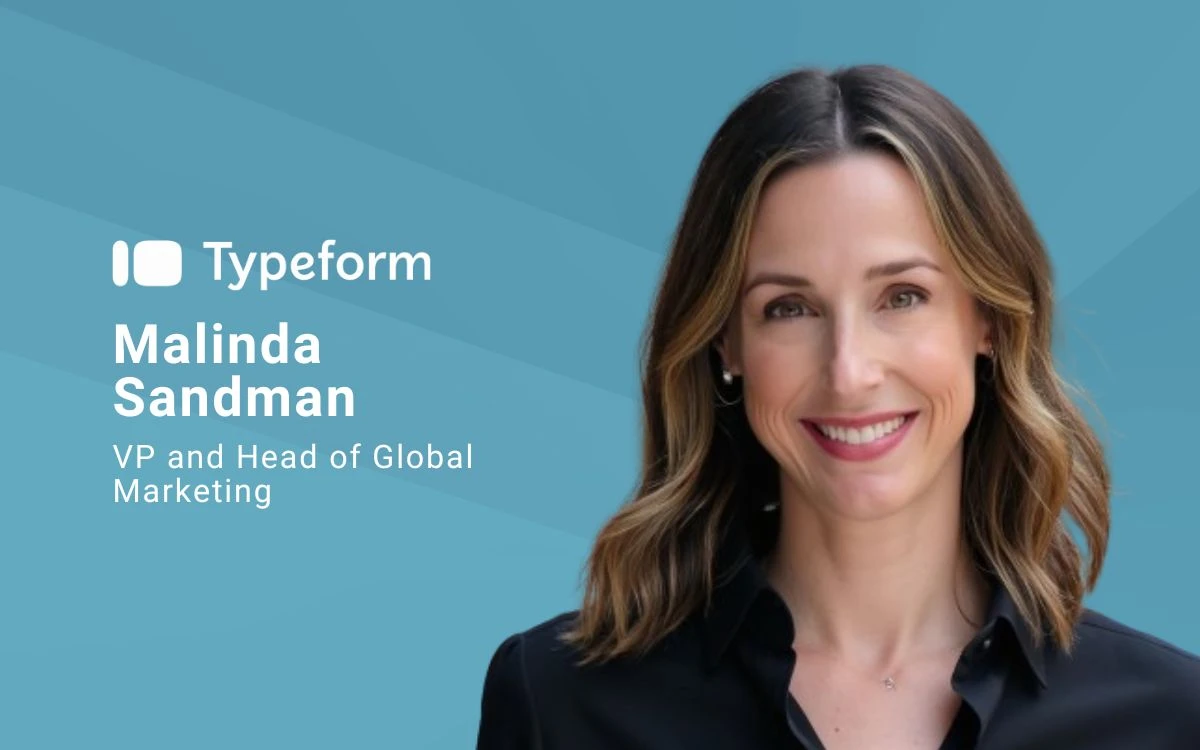
Malinda Sandman, the VP and Head of Global Marketing of Typeform