









An inquiry comes for customer support from a global client. The AI agent checks the problem and escalates it to the manager, but only when it is needed. Meanwhile, another AI agent updates the CRM, initiates a follow-up process, and generates a report for the management team.
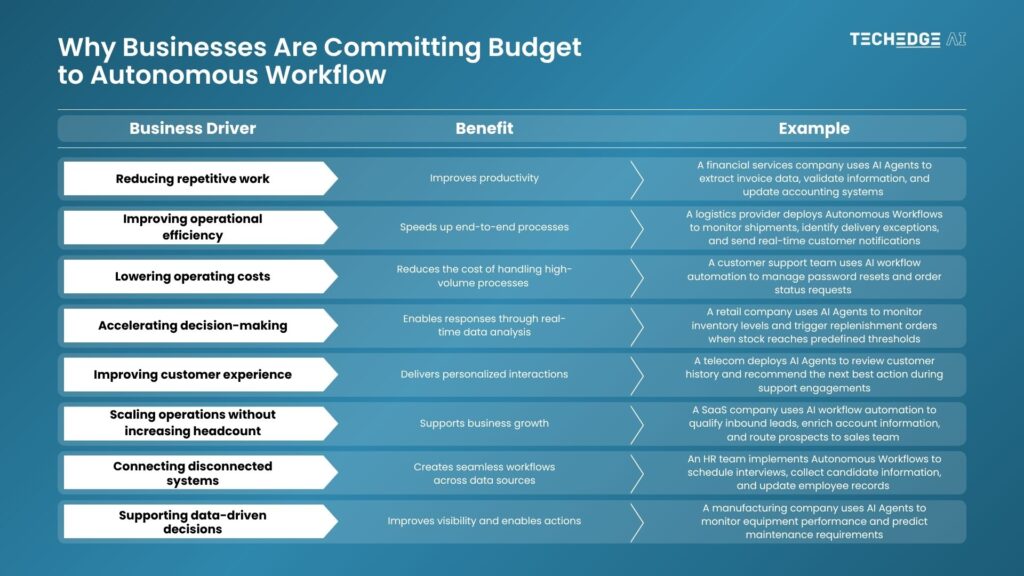
With the increasing use of AI workflow automation, organizations are beginning to work in new ways. Since AI agents have been incorporated into applications, they are now moving from productivity to operational helpers.
This article explains the shift in business operations through AI agents.
How Autonomous AI Works Beneath the Business Promises
Autonomous Workflows is an orchestration layer which ties up AI models with applications, databases, and communication systems.
An autonomous workflow follows several steps:
Data Gathering: AI agents collect data from several sources, thus creating the context that will be used by the AI agent to comprehend a business process.
Decision-Making and Reasoning: With the use of LLMs and business rules, the agent reasons through the information gathered and makes a decision regarding what to do next.
Action Performance: The AI agent performs actions like record updates, report generation, and customer/employee communication.
Monitoring: AI agents monitor the outcomes and adjust actions according to environmental changes. This feedback loop makes autonomous workflows dynamic.
AI workflow automation also relies on integration capabilities. AI agents’ interface with APIs, cloud, and applications to transfer data among systems. It allows companies to automate end-to-end processes.
Governance is still an important aspect underneath each autonomous system. Companies are setting up access and monitoring measures so that AI agents comply with regulations.
Autonomous AI Workflows Demand a Different Approach to Oversight
As organizations expand the use, traditional governance models are no longer sufficient.
1. Define Decision Boundaries
Not every decision should be fully autonomous. Organizations need to determine which tasks AI agents can execute independently and which require human approval.
AI Agents are permitted to handle customers’ questions while transactions exceeding a particular threshold require approval by compliance officers.
2. Audit Trail
All actions conducted by AI agents need to be documented for better transparency and compliance.
Healthcare providers keep a log of all recommendations made by AI agents.
3. Anticipating Exceptions and Escalations
An Autonomous Workflow needs to anticipate when it encounters problems it can’t solve and hand them off to employees.
The AI agent handling purchase orders forwards unusual contracts from suppliers to lawyers.
4. Develop Accountability Frameworks
Organizations need ownership for AI Agents’ decisions, including processes for investigating errors and addressing business impact.
A manufacturing company assigns operational leaders for autonomous workflows managing production planning and inventory allocation.
5. Measure the Results
Supervision must concentrate on precision, speed, and cost savings, not on how many tasks are automated.
The customer service assesses the results of AI automation in terms of speed of problem resolution and customer satisfaction score.
What Organizations Will Be In 2030 That Got Agentic AI Right
Organizations that have succeeded in adopting agentic AI by 2030 will be those who have managed to redesign the work done in their organization. The AI agents will handle workflows, make coordinated decisions, and implement processes. Organizations will no longer be judged on the number of AI technologies incorporated, but rather, whether they can develop models involving AI agents.