








A business firm gets ready to venture into a new market; there is a need to monitor industry trends. The firm’s research team takes days gathering information such as competitor website analysis, reports and products launches among others before the information gets to decisionmakers.
Using market intelligence automation tools, companies can shift from research reports to constant monitoring of changes in the market. Nevertheless, the power of AI market intelligence lies in their ability to distinguish significant events from market noise.
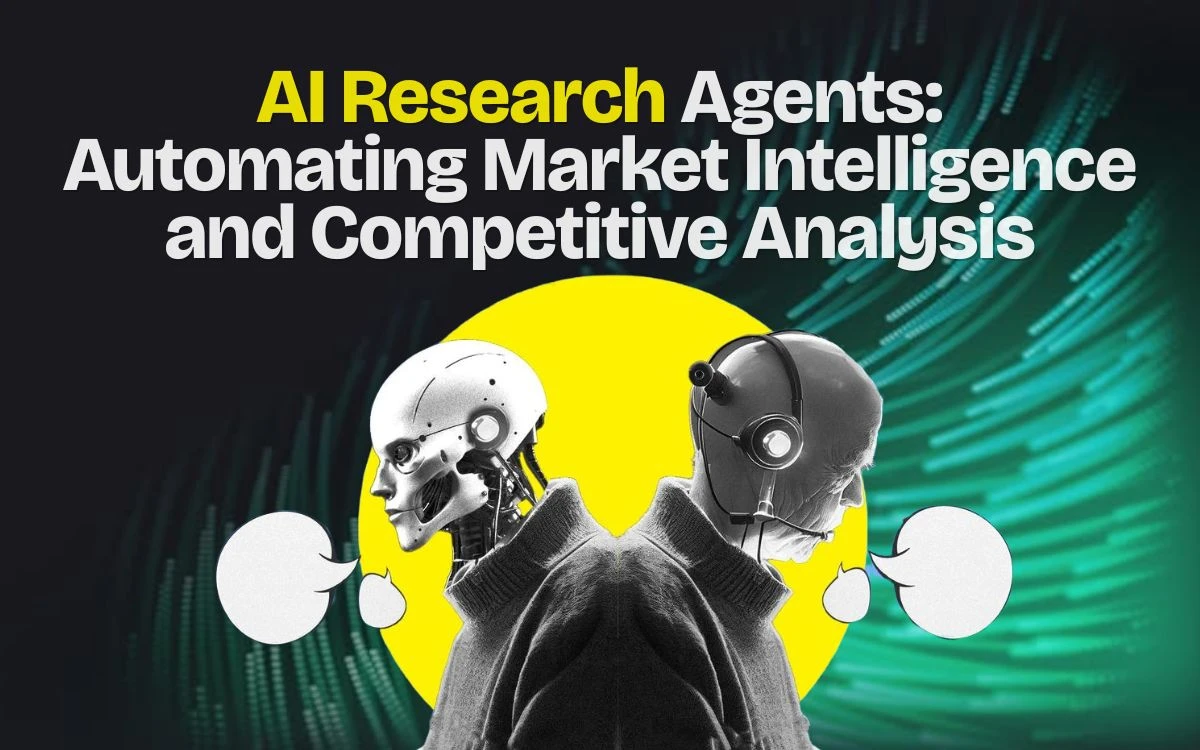
This article explains how AI research agents help market intelligence.
Intelligence Bottleneck Resolved by AI Research Agent
Competitive pricing, consumer sentiment, and industry developments are found scattered in various forms of media. It is only after analysts have gathered, authenticated, and correlated all these data points that they become useful to making a business decision. By which time, the market has already evolved.
Autonomous research agents can help solve this problem by monitoring information sources to detect change and synthesizing information. Nonetheless, automation alone doesn’t mean better intelligence. AI Market intelligence depends on how relevant its sources are and how accurate its analysis is.
AI Research Agents Are Leveling and Raising the Competitive Intelligence Bar
1. Market Intelligence is Now Accessible to Smaller Teams
Larger organizations have the upper hand in the research because of the capacity to fund analysts and information gathering. Market intelligence automation makes the process easier for smaller organizations to keep track of industry trends without establishing a large research team.
A fintech company uses an agent that monitors regulation changes, competing products, and customer feedback using available information. The organization uses information to identify shortcomings in their own products.
2. The Competitive Advantage Is Moving from Data Access to Interpreting It
The availability of more data does not make much difference anymore. The efficiency of AI market intelligence will depend on how well the team will be able to link the market trends to customer requirements and risks.
The agent knows that there are three firms using AI for customer service in the quarter. Rather than reporting three separate events, it provides information about shifts in customer demand trends.
3. Research is Creating New Expectations for Decision-Making
Time is reduced between market development and the discovery of development. Pricing, positioning, and product strategy decisions must be made based on evidence.
The firm uses its AI agent to collect evidence on pricing strategies, customer feedback, and market trends prior to entering the geographical market. The results form the basis for the decisionmakers’ initial evaluation.
4. Automation Intelligence Still Requires Human Verification
A research agent could misunderstand the context, depend on limited information, or create links that do not exist. In such circumstances, companies need to verify the procedure of decision-making.
The agent recognizes the price hike by one of the competitors and finds out about the trend in the market. The next step for the company would be to verify whether the trend applies to all competitors’ products, or whether it is a temporary promotional activity.
Measuring What AI Research Intelligence Changes
1. Research Turnaround Time
Measure time taken to go from a research request to validate discovery. The research of autonomous agents should help save turnaround time without affecting accuracy.
For instance, if a competitive analysis that used to take five working days is now taking two, the team would be able to explore any changes in the market. But it only makes sense if the quality of the analysis remains the same.
2. Analyst Productivity and Level of Investigation
Examine if the use of automation makes it possible for analysts to focus on interpretation, strategic thinking, and analysis rather than data collection.
Rather than manually checking 20 competitor websites each week, an analyst uses an agent to extract important information and utilizes the extra time to consider the potential impact on the company’s strategy.
3. Effect on Decision-making
Include Product priorities, price variations, sales positioning, or risk identification earlier in the process.
The sales team leverages competitor comparison using AI to highlight the consistent shortcomings of the rival offerings and keep track of the effectiveness of the updated messaging.
The Future Frontier
AI research agents are changing the mechanics of competitive intelligence, but their value remains a question of execution. As autonomous research agents are embedded in workflows, the real test for AI market intelligence will be the depth of analysis and the decisions that follow.