






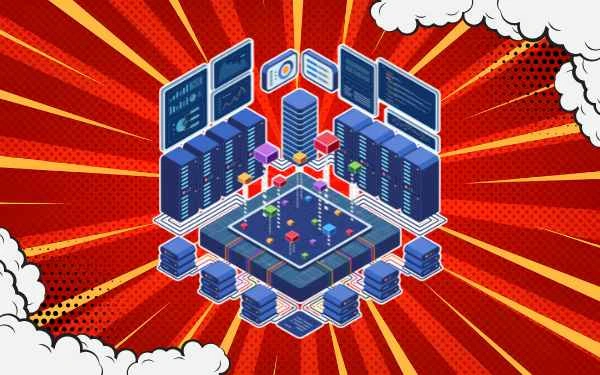
AI infrastructure is running into a problem that cannot be solved by faster GPUs alone: getting enough electricity to increasingly dense compute systems. As AI racks move toward much higher power levels, data center operators and server manufacturers are reassessing how electricity travels from the grid to accelerators. A new DIGITIMES Intelligence report, “AI Data Center 800VDC Power Architecture Takes Shape; Future Hurdles Require Balancing Multiple Key Factors,” examines the emerging shift toward 800VDC and its potential impact on power delivery, semiconductors and the broader AI infrastructure supply chain.
The next bottleneck in AI computing may sit outside the processor.
As large language models, generative AI applications and AI agents demand increasingly intensive workloads, data centers are packing more accelerators into each rack. That is turning electrical delivery into a system-level engineering problem involving power conversion, cabling, thermal management, space and reliability.
The International Energy Agency estimates that data center electricity consumption reached about 415 TWh globally in 2024 and could more than double to around 945 TWh by 2030 in its base case. Electricity consumption from accelerated servers, driven largely by AI, is expected to grow substantially faster than conventional server demand.
Gartner is seeing a similar acceleration. It forecasts worldwide data center electricity consumption will reach 565 TWh in 2026, up 26% year over year, while AI-optimized servers are expected to account for 31% of data center power consumption. Gartner also expects AI-optimized server power consumption to surpass conventional servers in 2027.
That growth is putting pressure on the traditional power architecture used by data centers.
Why 800VDC is gaining attention
Conventional facilities typically rely on multiple stages of AC and DC conversion before power reaches the server and ultimately the processor. As rack power increases, every conversion stage, conductor and connection becomes more consequential.
Higher-voltage DC distribution offers a different approach. At the same power level, increasing voltage reduces current, which can lower conductor requirements and reduce some distribution losses. It can also create more physical room for compute and cooling infrastructure.
NVIDIA has positioned 800VDC as an architecture for next-generation AI factories, arguing that fewer conversion stages can reduce distribution losses and copper requirements. The company is working with a broad ecosystem of power, semiconductor and infrastructure suppliers around the architecture.
The Open Compute Project is also working with NVIDIA, Google and Microsoft on standardizing 800VDC requirements for future AI infrastructure. The effort reflects a broader industry recognition that power architecture needs to evolve alongside accelerator performance rather than remain a separate facilities concern.
Schneider Electric estimates that AI racks are already moving beyond 400 kW in some designs, with future systems approaching the megawatt range. Its analysis argues that relocating significant power-conversion functions outside the IT rack can help address congestion and power-density constraints.
GaN and SiC enter a new power semiconductor contest
The 800VDC transition also creates opportunities—and strategic uncertainty—for power semiconductor suppliers.
Gallium nitride (GaN) and silicon carbide (SiC) are both increasingly relevant to high-efficiency power conversion, but their characteristics make them suitable for different parts of the power-delivery chain. Switching frequency, voltage tolerance, efficiency, thermal performance and system topology all influence where each technology fits.
That means the semiconductor market is unlikely to produce a simple winner-takes-all outcome.
Instead, suppliers may compete across different layers of the AI power stack, from high-voltage conversion and solid-state transformer systems to intermediate power stages and point-of-load conversion closer to accelerators.
The implications extend beyond individual devices. Power semiconductor companies will increasingly need to work with server OEMs, original design manufacturers, data center operators and system integrators during the architecture-design phase.
From component competition to system competition
That shift could change the competitive dynamics of AI infrastructure.
The DIGITIMES analysis argues that supply stability, system-level engineering capabilities and relationships with server OEMs and ODMs could become as important as individual semiconductor specifications. This is particularly relevant as AI server designs evolve faster than traditional data center infrastructure refresh cycles.
The Open Compute Project’s standardization work illustrates why interoperability could become another competitive factor. A common architecture can make it easier for equipment suppliers to build compatible power systems instead of developing isolated solutions for individual customers.
However, 800VDC does not eliminate the engineering challenges. Higher-voltage DC systems introduce requirements around protection, grounding, fault containment, isolation, energy storage and maintenance. Schneider Electric’s analysis similarly emphasizes that these systems require coordinated design across electrical conversion, storage and protection rather than simply replacing an existing power bus.
AI infrastructure is becoming an energy architecture problem
The significance of 800VDC ultimately goes beyond voltage.
AI infrastructure is increasingly being designed as an integrated system in which compute, networking, power, cooling and facility operations have to scale together. Gartner now describes power availability as a constraint on AI data center expansion, while the IEA has highlighted growing bottlenecks in transformers, power equipment and other infrastructure required to connect new facilities to the grid.
For data center operators, the question is therefore not simply whether 800VDC is more efficient than today’s architectures. It is whether the technology can become a reliable, standardized and economically practical foundation for increasingly dense AI deployments.
For semiconductor suppliers, the opportunity is broader still. The shift could redistribute value across power conversion, wide-bandgap devices, server power systems and infrastructure controls.
The next phase of AI infrastructure may consequently be defined as much by how efficiently electricity reaches the accelerator as by how powerful the accelerator itself becomes.
Market Landscape
The AI infrastructure market is moving from processor-centric optimization toward grid-to-chip efficiency. The IEA expects global data center electricity consumption to approach 945 TWh by 2030 in its base case, while Gartner forecasts data center electricity consumption at 565 TWh in 2026.
This environment is creating demand for higher-voltage DC distribution, solid-state power conversion, advanced cooling, energy storage and more efficient power semiconductors. NVIDIA, Google and Microsoft are participating in the Open Compute Project’s 800VDC standardization effort, while infrastructure vendors including Schneider Electric and Eaton are developing architectures around higher-density AI deployments.
The competitive opportunity therefore extends across AI infrastructure rather than being confined to GPUs. Power electronics, GaN and SiC devices, conversion systems, electrical protection, cooling and data center design are becoming increasingly interconnected parts of the AI compute stack.
Top Insights
- 800VDC is emerging as an AI infrastructure architecture designed to address higher rack power, lower current requirements and increasingly complex grid-to-chip power delivery.
- GaN and SiC are likely to serve differentiated roles, with performance, switching frequency, voltage and thermal requirements influencing where each technology fits.
- Power availability is becoming an AI scaling constraint, making electrical efficiency and infrastructure capacity strategic considerations for data center operators.
- Standardization could accelerate adoption, as NVIDIA, Google and Microsoft work through OCP to establish common requirements for next-generation 800VDC systems.
- The value chain is expanding beyond accelerators, creating opportunities for semiconductor, power-conversion, cooling, storage and data center infrastructure suppliers.
Power Tomorrow’s Intelligence — Build It with TechEdgeAI