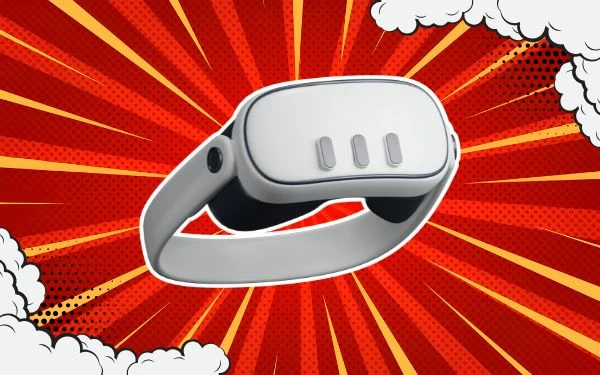
Unity is giving developers an early path to build applications for Meta’s upcoming VR Glasses, bringing support to its game engine months before the hardware reaches retail. Available through Unity 6.6 and Meta’s latest XR development tools, the integration is designed to let studios adapt existing Quest applications or develop new experiences around eye and hand interaction ahead of the device’s planned spring 2027 launch.
Unity has announced day-one engine support for Meta VR Glasses, giving developers access to development and testing tools before Meta’s next-generation virtual reality hardware reaches consumers in spring 2027. The move puts Unity’s OpenXR-based development environment directly into Meta’s preparation for a new device category centered on lightweight hardware, hand interaction and eye tracking.
For developers, the most significant part of the announcement is not simply hardware compatibility. Unity is positioning Meta VR Glasses as an extension of an existing development workflow, allowing studios with Quest applications to carry projects forward rather than building an entirely separate software stack.
Unity says VR Glasses development is supported in Unity 6.6 and later through OpenXR. Meta’s own developer documentation also identifies Unity as a supported development environment and says VR Glasses use the same operating system as Meta Quest, with SDKs and workflows designed to carry over.
That compatibility could reduce the engineering work required to prepare established VR applications for the new hardware. Meta says its VR Glasses require a 64-bit application architecture, while its compatibility documentation outlines additional considerations around device targeting and application behavior.
Building for controller-free interaction
The hardware also changes some of the assumptions developers have traditionally made about VR interfaces. Meta says eyes and hands are the primary input methods for VR Glasses, rather than conventional handheld controllers. That makes support for hand tracking, eye tracking and interaction design a more central part of application development.
Unity says its current tooling expands support for eye and hand interactions and includes tools for testing those experiences before developers have physical hardware. Its XRI Simulator, for example, can be used to preview interactions in the Unity Editor. Meta is also developing tools that can scan projects for readiness issues, including controller-to-hand migration and field-of-view considerations.
Graphics performance is another important consideration. Unity says its VR Glasses support includes a rendering mode designed to reduce GPU cost without an apparent reduction in visual quality. OpenXR-based rendering and eye-tracking capabilities are particularly relevant as developers balance image quality with the performance constraints of a lighter VR device.
OpenXR becomes the development bridge
The announcement also illustrates the growing role of OpenXR as a portability layer for immersive applications. Meta’s developer documentation says Horizon OS is fully compatible with Unity’s OpenXR implementation and that applications developed against conformant OpenXR platforms can run across supported environments, subject to platform-specific restrictions. Meta has also deprecated its older Oculus XR Plugin in favor of the Unity OpenXR Plugin for newer development.
For enterprise developers and studios, that matters because the development stack increasingly has to support multiple device types without creating completely separate application branches. A common engine, runtime standards and shared SDKs can reduce duplicated engineering work while allowing teams to optimize individual experiences for specific hardware.
Unity says studios working on launch content include Supernatural, Story of Seasons, Phoenix Wright: Ace Attorney Dual Destinies VR, Dice Throne Digital and Two Point Hospital – Mixed Reality Edition. Supernatural says it used Unity during a broader modernization of its application and is now using the engine to develop its VR Glasses experience. These statements come from the companies themselves and indicate early developer activity rather than independent measurements of platform adoption.
AI enters the XR development workflow
The development story also intersects with the broader shift toward AI-assisted software creation. Unity says developers can combine its command-line workflows with Meta’s AI tools in the SDK to begin adding VR Glasses support.
That points toward a wider trend in AI development platforms: generative and agentic tools are increasingly being integrated into established development environments rather than operating as standalone applications. In XR, these tools could eventually assist with project preparation, code generation, interaction prototyping and optimization, although the announcement does not establish specific production capabilities beyond the workflows described by Unity and Meta.
For the broader AI and machine learning ecosystem, the significance is therefore indirect. VR development remains primarily a real-time graphics and software-engineering problem, but AI-assisted tooling is becoming another layer in the development stack as platforms compete to shorten iteration cycles.
Meta’s VR Glasses will not reach retail until spring 2027, leaving developers several months to test applications and adapt user interfaces. Unity’s early support gives existing Quest developers a way to begin that work using familiar tools, while Meta’s SDK strategy provides a parallel path across Unity, Unreal, Android and web development environments.
The result is less a new standalone development ecosystem than an expansion of the existing Meta VR platform. The technical challenge for developers will be determining how effectively existing applications can translate to a device where eyes and hands replace traditional controllers and where performance, interface design and lightweight hardware impose different constraints.
Market Landscape
Meta’s VR strategy is moving toward a broader hardware portfolio while retaining Horizon OS and a shared developer ecosystem. VR Glasses are positioned as an addition to Quest rather than a replacement, with Meta emphasizing shared operating-system, Store and SDK infrastructure.
For Unity developers, OpenXR provides the technical bridge between existing VR development practices and newer hardware. The competitive landscape includes other major real-time 3D engines, particularly Unreal Engine, while Meta continues to provide its own SDK layer for platform-specific capabilities.
The broader development trend is toward cross-device workflows, simulation before hardware availability, controller-free interaction and AI-assisted development. These changes could make XR development increasingly dependent on flexible engines and standardized interfaces rather than device-specific codebases.
Top Insights
- Unity 6.6 adds a development path for Meta VR Glasses months before the hardware reaches retail in spring 2027.
- OpenXR allows existing Quest-oriented development workflows to move toward Meta’s next-generation VR hardware with fewer platform-specific changes.
- Eye and hand tracking become central development considerations because Meta VR Glasses are designed around controller-free interaction.
- Unity and Meta are adding simulation, readiness and optimization tools to let developers test applications before widespread hardware availability.
- AI-assisted development is entering the XR workflow through integrations between Unity’s tooling and Meta’s developer ecosystem.
Power Tomorrow’s Intelligence — Build It with TechEdgeAI