


Enterprise application upgrades are often described as simple, low-risk, or in-place. In real production environments, they are one of the most common moments when security controls quietly degrade.
Across financial services, healthcare, higher education, and large SaaS environments, the same pattern appears again and again: the upgrade completes successfully, applications return to service, monitoring dashboards show green—and weeks later teams discover security gaps that did not exist before the change window.
These failures are rarely caused by a single defect. Instead, they emerge from architectural assumptions, operational shortcuts, and misplaced confidence in automation. This article examines why enterprise application security so often breaks during routine upgrades and what experienced teams do differently to prevent it.
Modern platforms promise non-disruptive upgrades through rolling updates, in-service software upgrades, configuration preservation, and backward compatibility. These claims are usually technically accurate, but incomplete. They focus on availability, not security behavior.
An application can be reachable, responsive, and passing health checks while inspection paths have changed, enforcement logic has shifted, or fail-open behavior has been silently introduced. Availability survives the upgrade. Security assumptions often do not.
Most upgrade processes emphasize preserving configuration objects such as virtual servers, policies, profiles, and certificates. What they do not preserve is behavioral equivalence. A configuration restored onto a new software version may be parsed differently, executed in a new order, or influenced by updated defaults and deprecated logic.
Teams assume that because configuration objects look the same, protection is the same. In practice, security controls are systems, not static files.
Vendor documentation describes idealized upgrade paths built around clean environments and minimal customization. Real production environments reflect years of incremental tuning, emergency exceptions, and undocumented workarounds. Upgrades expose the gap between documentation and reality.
Automation is often positioned as the solution to upgrade risk, but it frequently hides it instead. Automated migration tools and bulk conversions optimize for completion, not correctness. Automation can reproduce flawed assumptions at scale, faster than any human.
Validation after upgrades typically stops at availability testing. Very few teams verify that inspection is still occurring, blocking behavior still triggers, or logging semantics remain unchanged. An untriggered alert looks identical to a functioning control—until an incident occurs.
Between major software versions, defaults change. Timeouts, thresholds, inspection order, and fail-open behavior evolve. When teams rely on defaults they never explicitly set, they inherit security changes they never reviewed.
Upgrade windows compress judgment. Teams prioritize restoring service and avoiding rollback. If nothing appears broken, the upgrade is declared successful. Security regressions surface later, owned by different teams and disconnected from the original change.
High-maturity organizations treat upgrades as security events. They establish pre-upgrade behavioral baselines, test negative cases, validate enforcement explicitly, and assume defaults have changed unless proven otherwise.
Enterprise application security rarely breaks because teams are careless. It breaks because upgrades are treated as mechanical tasks rather than systemic changes. The real question after an upgrade is not whether the application is up, but whether the system behaves the same way under stress, attack, and failure.
Until that question becomes standard practice, simple upgrades will remain one of the most reliable ways to weaken enterprise security—quietly and predictably.
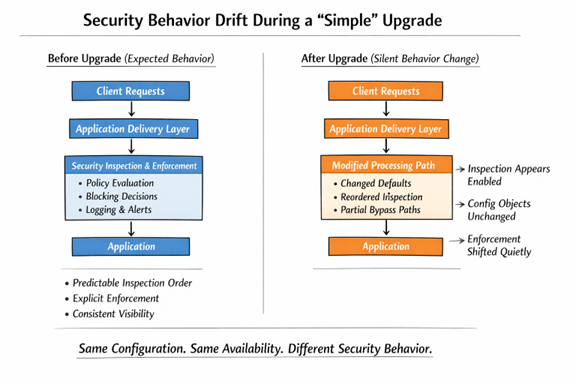
Illustration: Security Behavior Drift During an Upgrade
Figure 1: Security behavior drift during a “simple” upgrade. The diagram illustrates how preserved configuration and uninterrupted availability can still result in altered inspection order, enforcement behavior, and reduced visibility after a platform upgrade.
About the Author
is an enterprise security and application delivery practitioner working with large-scale production environments. His work focuses on translating real-world operational failures into practical architectural guidance for security and infrastructure teams.

Vishnu Gatla is an enterprise security and application delivery practitioner working with large-scale production environments. His work focuses on translating real-world operational failures into practical architectural guidance for security and infrastructure teams.