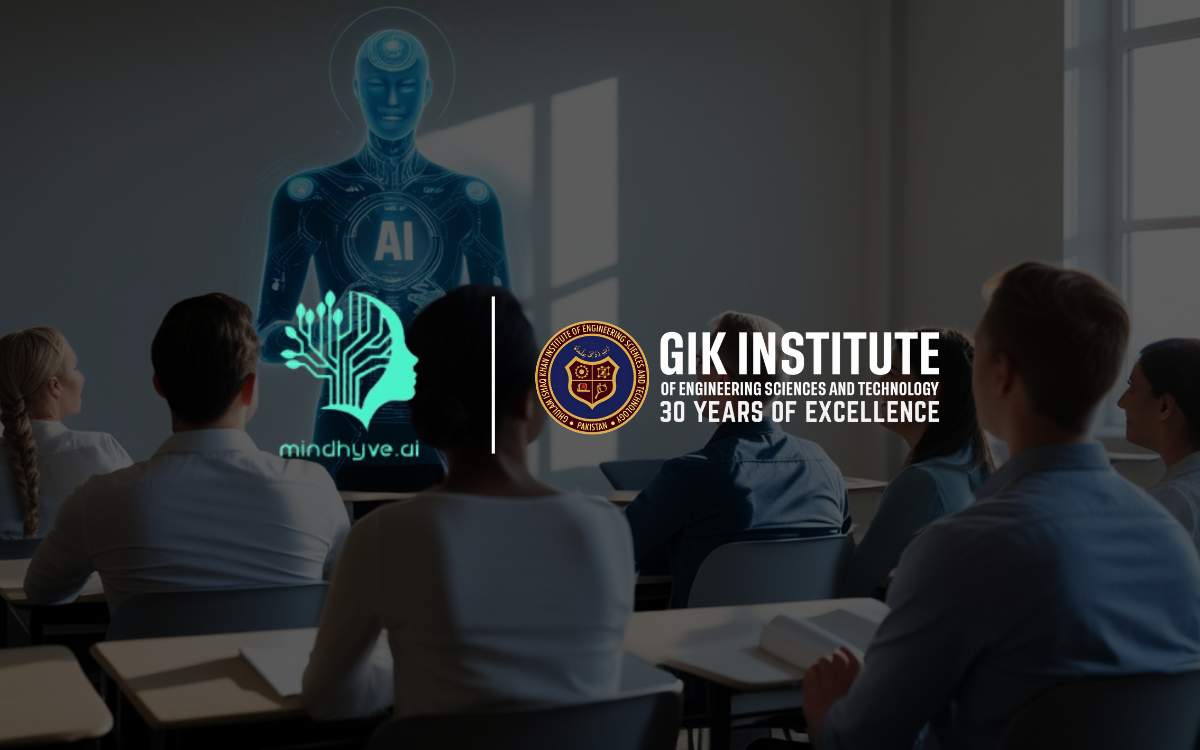


Artificial intelligence has been inching toward the center of higher education for years, but one partnership is pushing an entire region forward in a single, decisive leap. MindHYVE.ai a U.S. startup focusing on agentic AI systems—has entered a strategic alliance with Pakistan’s Ghulam Ishaq Khan Institute of Engineering Sciences and Technology (GIKI) to bring large-scale intelligent learning infrastructure to a major South Asian university.
The move gives Pakistan its first fully AI-enabled higher education institution and places GIKI in the same conversation as global early adopters experimenting with AI-native campuses. For MindHYVE, it’s an opportunity to prove that its flagship platform ArthurAI—an agentic learning and institutional intelligence system—can support not just classrooms but entire academic ecosystems.
A Different Kind of Campus Rollout
Plenty of universities worldwide are deploying AI tools piecemeal—tutoring bots here, grading assistants there. GIKI’s approach is more ambitious: a top-to-bottom adoption of ArthurAI across student learning, faculty workflows, course delivery, and administrative intelligence.
MindHYVE pitches ArthurAI as a system that doesn’t just augment learning but anticipates it, adapting in real time to student performance and instructional needs. That promise puts ArthurAI closer to agentic AI platforms like Khanmigo or Microsoft’s Copilot for Education—but with a stronger emphasis on institution-wide analytics and deeply personalized learning pathways.
GIKI expects thousands of students and faculty to use the system, spanning engineering, sciences, and interdisciplinary programs. The goal isn’t simply to introduce AI but to re-architect the educational model around it.
Why Now? The Global Context
If this sounds like a bold move, it is—but it’s also increasingly in line with global trends. According to reports from UNESCO and the World Economic Forum:
- 85% of institutions worldwide plan to integrate AI-driven learning systems by 2030.
- Two-thirds of future jobs will require AI literacy or deeper digital fluency.
- The AI-in-education market is on track to surpass $25B by 2027, driven by adaptive learning and intelligent tutoring technologies.
GIKI wants to be early—not just compliant—when the AI wave hits at full force. Pakistan’s higher education landscape has seen patchy digital adoption, but GIKI has historically been among the region’s tech-forward institutions. This partnership marks one of the country’s biggest steps toward AI-enabled academia, making the Institute a regional test case for what future universities could look like.
What the Deployment Actually Includes
MindHYVE and GIKI have outlined several core initiatives:
- Adaptive Learning Pathways: Students receive personalized course maps, real-time progress diagnostics, and content tuned to their strengths and weaknesses.
- AI-Assisted Teaching: Faculty gain tools to analyze learning outcomes, refine course design, and build assessments with predictive insights.
- Institutional Intelligence: Administrative and academic planning gets its own AI layer, aggregating campus-wide data into actionable intelligence.
- The Dawn Directive: A global AI fluency and ethics curriculum authored by the California Institute of Artificial Intelligence (CIAI), powered via MindHYVE’s agentic ecosystem. This could set a new baseline for AI literacy in Pakistan.
If executed as described, GIKI would become one of the first universities in Asia—possibly globally—to run on a unified agentic AI backbone rather than a fragmented mix of vendor tools.
Leadership’s Take: Ambition Meets Opportunity
Bill Faruki, Founder and CEO of MindHYVE, calls the partnership “a turning point.” In his view, the future of learning won’t look like today’s LMS-driven experience. Instead, it will be “dynamic, predictive, and profoundly human-centered”—a line that underscores the tension at the heart of modern AI adoption: automation versus personalization.
GIKI’s Rector, Dr. Fazal Khalid, echoes that sentiment but focuses on national impact. For him, the collaboration represents a chance to “reshape the future of academic excellence in Pakistan” and set a benchmark for intelligent education across South Asia.
Their combined vision is clear: not to play catch-up with Western AI-enabled institutions but to match or exceed them.
Competitive Landscape: A Smart Bet?
MindHYVE enters a space heating up quickly. Major players like Google, Microsoft, and OpenAI are building education-focused agents, often bundled with productivity ecosystems. Meanwhile, niche startups are pushing AI tutoring, assessment, and analytics.
MindHYVE’s differentiator is its fully agentic, institution-wide design—a bet that universities will want coherent AI systems rather than patchwork solutions. If GIKI’s rollout succeeds, it could become a case study for similar deployments in Asia, Africa, and the Middle East.
For Pakistan, the timing is especially significant. As the country pushes for digital transformation amid global talent shortages, AI fluency could turn into a competitive national asset. Partnerships like this could accelerate that shift.
The Road Ahead
GIKI’s AI-enabled transformation won’t happen overnight. True agentic learning environments require careful implementation, data governance frameworks, faculty training, and cultural buy-in. But the Institute’s willingness to dive in early suggests a long-term commitment—and potentially a new model for universities looking to future-proof their academic infrastructure.
If Pakistan’s first AI-native university delivers measurable outcomes—improved learning performance, greater teaching efficiency, stronger research pipelines—it may spur similar alliances across the region. And MindHYVE, still early in its growth cycle, could find itself competing not just with EdTechs but with major global AI platforms.
For now, GIKI is betting on the next generation of AI-driven education. And MindHYVE is betting that its agentic model can scale from a single university to an international standard.
Power Tomorrow’s Intelligence — Build It with TechEdgeAI