








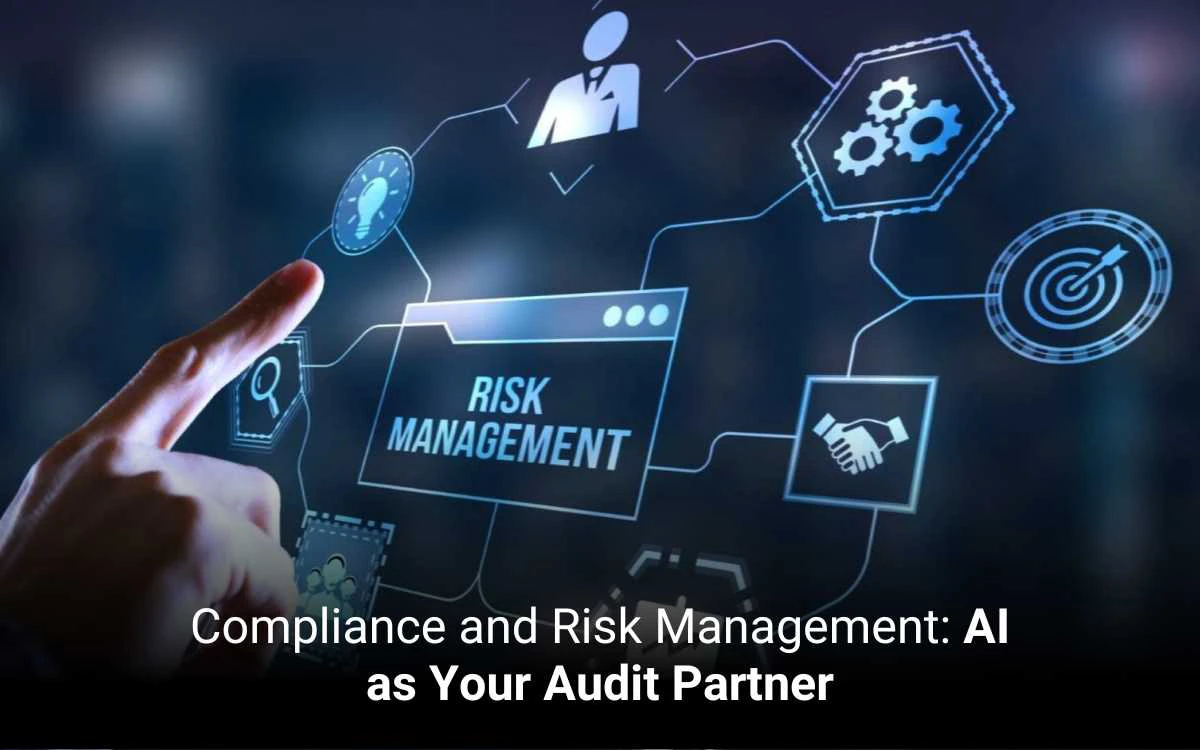
A financial firm prepares its annual compliance audit. Despite best efforts, errors slip through, escalating compliance risks, leading to longer audit cycles and potential penalties. But what if audits are no longer stressful but intelligent and predictive? This is how AI can become your ideal audit partner.
AI identifies anomalies, flags potential issues, and even predicts where future risks may emerge. Unlike traditional audits, AI-driven systems analyze transactions in real-time, leaving no blind spots. For example, AI models can detect suspicious activity patterns that indicate potential fraud or AML (Anti-Money Laundering) risks before auditors.
This article will discuss how AI can help you audit compliance and risk management.
Why Compliance and Risk Teams Are Adopting AI-Driven Audits
Compliance and risk teams are adopting AI-driven audits because they offer speed, scale, and confidence.
1. Audits are Becoming Continuous, Not Periodic
The traditional audit process is a point-in-time activity, performed either on an annual or quarterly basis. However, in the present scenario, where transactions, data access, and compliance are being performed on a daily basis, this approach is no longer valid.
Example: A SaaS company uses AI to stay on top of access controls on a continuous basis, ensuring that audit evidence is always up-to-date and not compiled at the end of the audit cycle.
2. AI Minimizes the Manual Process of Data Collection
The most time-consuming activity for the compliance team is data collection to perform audits. AI helps in the automatic collection, validation, and organization of logs, policies, approvals, and control data.
3. Control Gaps are Detected Earlier, Which Reduces Audit Risk
AI-based audits detect anomalies and control weaknesses in real-time, not during an audit months later.
Example: A fintech business uses AI to point out missing KYC documents in real-time, which are addressed before auditors point out the issue as a finding.
4. Consistency in Global Operations
For global businesses, audits can reveal inconsistencies across regions. AI enforces compliance rules consistently, which means fewer differences across regions.
Why Manual Audits Fall Short and How AI Fills the Gap
Manual audits fall short in a world of real-time risk. AI fills the gap by enabling continuous, scalable, and consistent compliance.
1. Manual Audits are Retrospective
The traditional audit is a retrospective process. It examines what occurred weeks or months before, well after the problem has already existed. In today’s changing world, this creates blind spots.
Example: An annual audit reveals access control problems to a SaaS company months after the problem has already existed.
2. Sampling Overlooks Hidden Problems
Manual audits are necessarily based on sampling because of resource and time limitations. This means that many transactions or activities are never examined.
How AI improves: AI examines the entire data set, not just a sample, which means that hidden problems are less likely to be overlooked.
3. Human Processes Don’t Scale with Complexity
As the organization size increases, the audit scope also widens across systems, geographies, and regulations. The human audit process scales linearly with the number of employees, whereas AI scales horizontally. It means that the AI process will not be affected by the complexity of the organization.
4. Inconsistent Execution Increases Risk
The human audit process is performed by different auditors, and the results are not consistent. The AI process follows rules, which makes it more consistent.
The Evolution of Auditing: Human Expertise + AI Insights
The future of auditing is not human versus AI, its human expertise amplified by AI insights.
1. Handling Scale is a Strength of AI; Context is the Role of Human Auditors
businesses process millions of transactions and system events. AI processes this data to spot anomalies and patterns. Human auditors review business context to separate real risk from operational variability.
2. Enhancing Consistency and Objectivity
AI enforces rules in a consistent manner across regions and teams, minimizing human bias. Humans ensure that these rules are in sync with regulatory intent and business objectives.
3. Improving Audit Insights, Rather Than Just Efficiency
Although AI accelerates the audit process, it also offers insights. Predictive analytics can help in the identification of possible risks, and organizations can improve controls before risks materialize.
4. Improving Collaboration Between Auditors and Management
The outcome of Explainable AI improves communication with stakeholders and regulators.
5. Governance and Ethics Remain Human-centric
It is humans who set the boundaries of audit scope, risk, and ethics. AI operates within these boundaries.
Conclusion
Compliance and risk management are dynamic, data-driven disciplines that demand speed, accuracy, and foresight. AI steps in as audit partners, not just tools, but to empower organizations to stay compliant and make informed decisions.
Train your compliance and risk team with AI-driven intelligence and turn your audits into a strategic advantage.