









Tencent Cloud has introduced its AI-Native Productivity Flywheel, a framework designed to help enterprises turn individual AI productivity gains into scalable organizational capabilities. Built around three pillars — AI-Native Workflow, AI-Native Tech Architecture, and AI-Native Organization — the framework emphasizes human-AI collaboration, enterprise knowledge management, and workflow automation. The announcement highlights a growing shift in enterprise AI adoption: moving beyond employee-facing AI tools toward integrated systems that can capture institutional knowledge, improve decision-making, and support organization-wide innovation.
Tencent Cloud Targets Enterprise AI Transformation With Productivity Flywheel
Enterprise adoption of artificial intelligence is entering a new phase. While generative AI tools and AI assistants are helping employees complete individual tasks faster, organizations are increasingly facing a more difficult challenge: translating those productivity improvements into measurable business outcomes across entire teams and operations.
Tencent Cloud is addressing this challenge with its AI-Native Productivity Flywheel, a framework designed to integrate AI into enterprise workflows, technology infrastructure, and organizational structures.
The company introduced the framework through a keynote delivered by Freda Xu, Vice President of Tencent Cloud and Head of Marketing and International Marketing and Public Relations, at the Women x Innovation x A Brighter Tomorrow Forum in Hong Kong.
Her presentation, titled “Women’s Leadership in the AI Era: How to Lead a Human-AI Co-Working Team,” explored how AI is changing individual productivity, workplace collaboration, and organizational innovation.
The central argument is that deploying AI tools across an organization is not enough. Businesses must also develop processes that allow employees to share expertise, preserve institutional knowledge, and build on successful practices.
From Individual AI Productivity to Organizational Intelligence
Generative AI has created opportunities for employees to operate as what Tencent Cloud describes as “super individuals.” AI assistants can help workers generate content, analyze information, automate repetitive activities, and accelerate research.
However, individual productivity improvements do not automatically translate into organization-wide performance gains.
Knowledge often remains fragmented across employees, documents, meetings, cloud storage, and disconnected business applications. When employees leave or teams change, valuable expertise can become difficult to access and reuse.
Tencent Cloud’s framework seeks to address this problem by treating organizational knowledge as an asset that AI systems can help capture, organize, and distribute.
A central part of this approach is the evolution of AI agents from standalone productivity tools into what Xu describes as “AI colleagues.” These systems can participate in knowledge management, workplace collaboration, and decision-support processes.
Tencent’s WorkBuddy platform is positioned as an example of this model. Rather than focusing exclusively on individual task completion, the AI workspace is designed to take over repetitive and process-driven activities while helping employees concentrate on responsibilities requiring creativity, judgment, and human interaction.
This approach reflects a broader enterprise AI trend: integrating AI assistants with internal knowledge repositories and business applications so that they can support complete workflows rather than isolated prompts.
Three Pillars of the AI-Native Productivity Flywheel
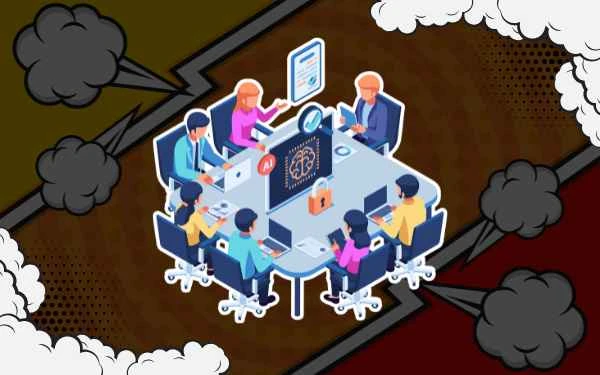
Tencent Cloud’s framework consists of three interconnected components.
1. AI-Native Workflow
The first pillar focuses on redesigning how employees and AI systems work together.
By connecting workplace applications, enterprise knowledge, documents, meetings, cloud storage, and business systems, organizations can provide AI agents with more relevant operational context.
This can enable AI systems to move beyond generating responses toward supporting task execution across business processes.
2. AI-Native Tech Architecture
The second pillar establishes the technical foundation required for enterprise AI deployment.
Tencent Cloud identifies security, reliability, and scalability as essential requirements. Enterprises need infrastructure capable of supporting AI applications while connecting different business systems and managing organizational information.
This layer is particularly important as businesses move from isolated AI experiments toward production environments involving multiple agents, applications, and data sources.
3. AI-Native Organization
The third pillar addresses organizational change.
AI adoption requires more than technology deployment. Companies must rethink management practices, workforce development, knowledge-sharing processes, and organizational culture.
Tencent Cloud’s approach places human-AI collaboration at the center of this transformation, with employees expected to work alongside AI systems rather than simply hand over responsibilities to automation.
The three pillars are designed to reinforce one another. Workflows capture knowledge, technology infrastructure makes it accessible and scalable, and organizational practices encourage employees to share and improve that knowledge.
Enterprise Deployments Highlight Productivity Gains
Tencent Cloud also presented examples from C&S Paper and Suning.com to illustrate how its AI-native approach can be applied to operational business processes.
C&S Paper, a tissue and personal care products manufacturer, uses WorkBuddy for business analytics and retail operations. According to Tencent Cloud, analyses that previously required two to three employees working together for an entire week can now be completed in approximately half a day.
The company also uses AI to identify high-potential retail outlets across a network of more than four million stores. Its analysis considers consumer traffic, purchasing power, competitive presence, and historical sales performance to support differentiated product assortment strategies.
Tencent Cloud further reported that C&S Paper recorded a 78% year-on-year increase in net profit during the third quarter. However, the announcement does not establish that AI adoption alone caused this increase.
These examples illustrate the distinction between automating individual tasks and using AI to improve broader business processes. Faster analysis can help employees spend more time interpreting results, developing strategies, and making operational decisions.
WorkBuddy is central to Tencent Cloud’s approach. The company reports that the platform has processed more than nine billion task requests, serves over 50% of Fortune China 500 companies and more than 60% of China’s Top 100 enterprises, and has received recognition in third-party AI product rankings and IDC enterprise agent evaluations.
These are company-reported adoption figures, rather than independently audited measures of productivity or financial impact.
Enterprise AI Moves Toward Organizational Transformation
The framework arrives as businesses increasingly look beyond standalone generative AI assistants toward integrated enterprise AI systems.
McKinsey’s 2026 State of AI research reports that 44% of respondents say their organizations are scaling AI across the enterprise, up from 38% a year earlier. This suggests that the next phase of enterprise AI competition will increasingly involve workflow redesign, infrastructure integration, and organizational readiness.
For Tencent Cloud, the AI-Native Productivity Flywheel provides a structured approach to this transition. Its effectiveness will ultimately depend on how well enterprises connect AI systems to reliable business data, establish governance controls, measure productivity outcomes, and encourage employees to adopt new ways of working.
The broader message is that enterprise AI transformation is not simply a technology procurement exercise. It requires organizations to redesign how knowledge moves, how decisions are made, and how employees collaborate with intelligent systems.
As AI agents become more capable, companies that successfully combine technology investment with workforce development and organizational change could be better positioned to turn individual productivity gains into sustainable competitive advantages.
Market Landscape
Enterprise AI is shifting from individual productivity tools toward integrated AI ecosystems that connect employees, business applications, internal knowledge, and automated workflows.
Three developments are shaping this market:
- Enterprise AI agents: AI agents are increasingly being deployed to support multi-step business processes, knowledge management, and decision support.
- AI-native infrastructure: Organizations need secure, scalable architectures that connect foundation models, enterprise data, applications, and workflow automation.
- Organizational transformation: AI adoption increasingly requires changes to employee responsibilities, management practices, workforce skills, and knowledge-sharing processes.
McKinsey’s 2026 research indicates that 44% of surveyed organizations are scaling AI across their enterprises. This highlights the growing importance of moving beyond isolated AI experiments.
Tencent Cloud’s framework reflects this transition by connecting workflow redesign, technical infrastructure, and organizational development.
Its competitive challenge will be demonstrating measurable enterprise outcomes against the expanding ecosystem of AI platforms from Microsoft, Google, Amazon Web Services, Salesforce, and other enterprise technology providers.
Top Insights
- Tencent Cloud’s AI-Native Productivity Flywheel connects workflow redesign, enterprise technology architecture, and organizational transformation.
- WorkBuddy is positioned as an AI workspace for knowledge management, collaboration, content creation, and task execution.
- C&S Paper reportedly reduced complex business analysis from one working week to approximately half a day using WorkBuddy.
- Tencent reports more than nine billion WorkBuddy task requests and adoption across major Chinese enterprises.
- The framework emphasizes converting individual AI productivity improvements into reusable organizational knowledge and capabilities.
Power Tomorrow’s Intelligence — Build It with TechEdgeAI