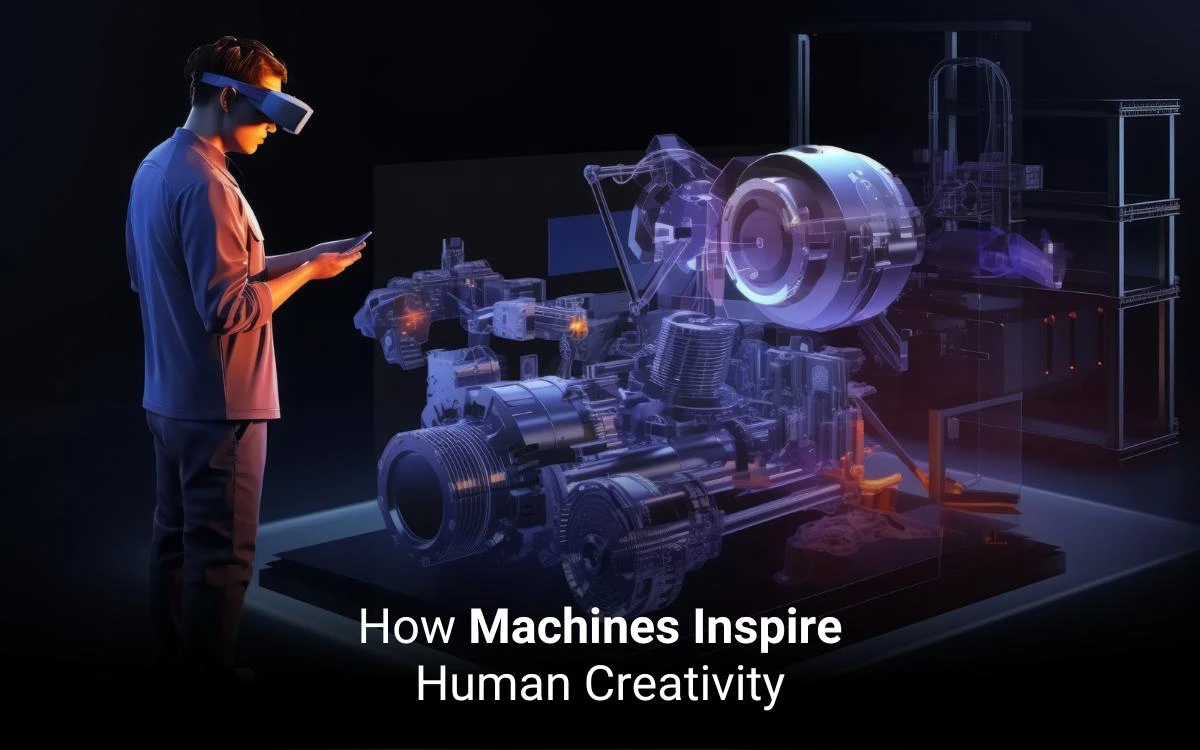
Think of a designer working, looking for that spark to bring a new product concept alive. She opens a design tool powered by AI, generating fresh ideas she might never have considered. It’s a snapshot of how technology and imagination relate to evolution: machines aren’t just tools anymore, but collaborators extend the ability of humans to create.
Nowadays, these Machine Learning systems are redesigning the way one thinks, designs, solves problems, and innovates. Today, it’s all about Human-centered AI. It provides starting points, removes obstacles, and gives a sandbox to experiment in. Machines bring speed and scale whereas humans bring context, emotion, and the ability to interpret meaning.
The following article deals with the relation between machines and human creativity.
Machine Technologies to Enhance Human Creativity
Key technologies enhancing Human Creativity are described below.
1. Generative AI Platforms
Learn from the patterns in data to create innovative designs, content, and solutions.
How it sparks creativity: Stimulates creativity; accelerates the pace at which ideas are generated and teams move.
Example: A fintech startup uses a generative AI engine to rapidly prototype customer journey flows, allowing product teams to explore 20–30 design directions in minutes, not days.
2. Predictive and ML Analytics
Identify future trends, detect patterns, and reveal unseen opportunities.
How it sparks creativity: It lets leaders reimagine strategies through creative decisions with informed, data-driven foresight.
Example: A SaaS supply chain platform uses machine learning-driven forecasting to simulate new fulfillment models.
3. Intelligent Automation Tools
Automate repetitive tasks with the use of rule-based systems and ML.
How it enhances creativity: Frees humans to devote time to problem-solving and ideation.
Example: An HRTech firm uses intelligent automation to respond to routine employee enquiries.
4. AI-Augmented Design
Assist with visual design, UX mockups, architectural layouts, and structural modeling.
How it enhances creativity: Develops the imagination by providing variants to inspire new thoughts.
Example: An industrial manufacturing company makes use of AI CAD tools to investigate alternatialternativens for machine components.
5. Cognitive Search Engines
Surface relevant insights from knowledge repositories using natural language understanding.
How it drives creativity: It helps teams connect the dots across functions and find innovations across domains.
Example: A global consulting firm applies cognitive search to map past case studies and find opportunities for new service offerings.
6. Virtual Collaboration Platforms
Enable distributed teams to brainstorm and build on one another’s ideas with the help of AI.
How they enhance creativity: Enhancing group innovation by generating ideas and giving structured support.
Example: A technology company uses AI-powered collaboration whiteboards able to suggest frameworks, templates, and creative prompts.
Benefits of Machine-Inspired Creativity
The key benefits of machine-inspired creativity are outlined below.
1. Accelerated Innovation Cycles
Machines help teams go from concept to prototype.
Impact on Creativity: This allows leaders to explore more ideas and identify winning concepts early.
Example: SaaS cybersecurity company is using ML simulation in testing its new threat prevention models to cut down innovation cycles.
2. Operational Challenges Overcome
Machines bring forth unexpected patterns and ideas independent of human biases.
Impact on creativity: Teams are given access to unusual solutions, fostering breakthrough thinking.
Example: A financial services firm uses Human-centered AI to identify customer segments, spurring new lines of products.
4. Teams Empowered to Think Strategically
The advantage of automation is that it gets rid of repetition and frees time for ideation in strategy.
Impact on Creativity: Human talent can invest more effort in conceptual thinking.
Example: A provider of HRTech uses AI-driven workflow automation to reduce the administrative workload.
5. Cross-functional Collaboration
AI platforms allow departments to co-create, share insights, and iterate.
Impact on creativity: Different perspectives stressfully, yielding better ideas.
Example: Global consulting firms use AI collaboration systems to co-develop solutions across geographies.
6. Democratization of Creativity Across the Organization
Human-centered AI enables non-technical teams to innovate.
Impact on creativity: Creativity is a capability, not a specialized function.
Example: A manufacturing company equips the frontline with ML-driven insights that enable them to make proposals for product and process improvements.
The Future of Creativity in a Machine-Augmented World
Below are defining shifts that shape this future:
1. Creativity Becomes a Capability
Predictive analytics, customer sentiment modeling, and real-time data streams will drive creative decisions.
Impact: Business leaders will blend intuition with quantitative insight to power innovation.
Example: A payment company uses ML-based behavioral analytics to build dashboards and workflows for customers.
2. Co-creation is the New Normal
AI will act as a “creative partner,” therefore brainstorming alternatives, refining ideas, and proposing solutions.
This will allow teams to explore the creative boundaries and experiment with possibilities they may never have envisioned.
For example, the engineering services company applies AI-based generative design tools in the development of energy-efficient machine parts by working closely with R&D teams.
3. Solutions Become a Competitive Differentiator
With Machine Learning, an organization can conceptualize and build solutions targeting specific business requirements.
Impact: Creativity shifts from conceptualization to the accurate solving of a problem.
Example: Through AI, a MarTech agency crafts custom campaign framework for clients by considering industry, behavior, and intent data.
4. Learning Fuels Continuous Creativity
Organizations will invest in hybrid skills that include creative reasoning with AI fluency.
Outcome: Teams become more adaptive, imaginative, and future-ready. Example: A consulting firm incorporates AI literacy programs in leadership development to drive creative problem-solving.
Conclusion
In B2, machine-inspired creativity has helped design the platforms, build the workflows, imagine new market opportunities, or accelerate R&D. Machines expand the canvas on which innovation occurs. Those who treat creativity as a strategic asset will be leading with far more innovative ideas and resilience against change.